
The Story of My Afro-Native Ancestors in Isle of Wight

Updated: 2 days ago
Note: This is a familial narrative based on documentation, family oral history, and DNA evidence.
Core Family Surnames: Mitchell, Vann/Vaughn/Vaughan, Rodgers/Rogers, Watkins, Walden, English, Mumford/Munford, Stagg/Staggs, Parker, Cobb
To understand why my ancestors were documented as mulatto in Virginia, we must understand the laws during that time.
In “An act declaring who shall not bear office in this country,(October 1705)” passed in October 1785, the General Assembly establishes eligibility requirements for holding office. It also provides a legal definition of “mulatto.” “And for clearing all manner of doubts which hereafter may happen to arise upon the construction of this act, or any other act, who shall be accounted a mulatto, Be it enacted and declared, and it is hereby enacted and declared, That the child of an Indian and the child, grand child, or great grand child, of a negro shall be deemed, accounted, held and taken to be a mulatto.”-Author: General Assembly (https://encyclopediavirginia.org/primary-documents/an-act-declaring-who-shall-not-bear-office-in-this-country-october-1705/ ) Source: William Waller Hening, ed., The Statutes at Large; Being a Collection of All the Laws of Virginia from the First Session of the Legislature, in the Year 1619, (Philadelphia: R. & W. & G. Bartow, 1823), 3:250–252
During this time, a child of an Indian and a white person was also documented as mulatto. Currently, the term is used for people of African and European descent. In this specific location and time period, it was used to refer to people of any non-white lineage, including those of Native descent (in the case of my ancestors).
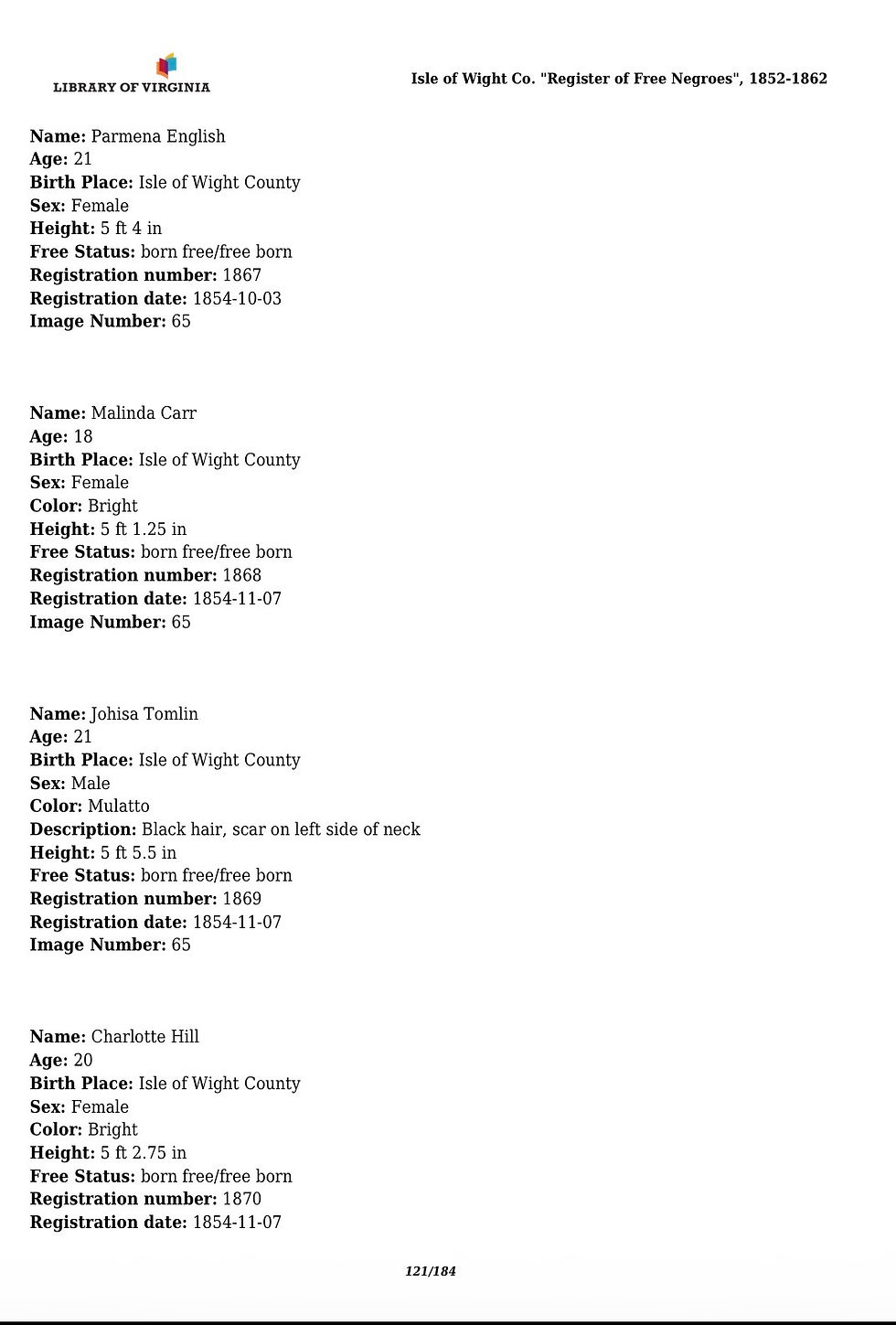
My 4th great-grandmother, Parmena “Parma” Mumford, was born free around 1833 in Isle of Wight, Virginia. Documented as "Mulatto" showing she was a multiracial woman in the 1854 Register of Free Negroes, she lived a testament to a complex colonial legacy. The 1854 register captures a moment of nuance where the state still distinguished between 'Mulatto' and 'Negro' classifications, as seen in the contrasting entries for Parmena English and some of her neighbors. For instance, Elizabeth Holland is listed as Negro with a bright complexion (this light complexion is likely from European lineage, also making her multi-racial). Parma also lives on the same street as the Holloway family, which is one of the surnames recorded by James Mooney in 1901 of Nansemond households in Norfolk, Virginia. The specific designation of Mulatto serves as a historical marker of Parma's triracial heritage before the 1924 Racial Integrity Act systematically collapsed these distinct identities into a rigid racial binary (colored and white).

Transcription: "No. 1867. Parmena English, a Mulatto Woman, twenty-one years old, five feet, four and 3/4 inches high— and born free in Isle of Wight County— and registered the 3d. day of Octo. 1854, by order of Court made the 2d. Octo. 1854."
Through DNA testing of direct maternal descendants, it has been confirmed that she carried the H1a3 maternal haplogroup.
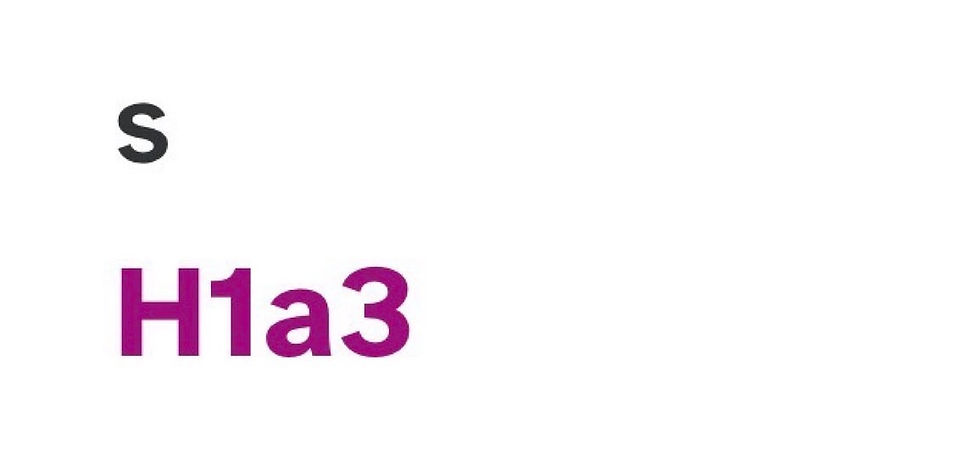
This confirms Parma’s descent from a white woman of English or Scots-Irish heritage who likely arrived in the colonies as an indentured servant.
The Convergence of Worlds
Parma’s paternal ancestor was most likely a multiracial Indigenous man (of West/Central African, Malagasy, and Native lineage) whose ancestors were enslaved by the Munford family or a free man of color. Under Virginia’s 1662 law, which made a child’s legal status follow the mother's, Parma and her siblings were born free. While she carried the Mumford name, she lived as a Free Woman of Color in the Great Dismal Swamp.
Her paternal heritage was forged in the early 1700s by the titans of the Virginia frontier. Robert Munford and his associates in Prince George County were "Indian traders" who pushed along the Great Occaneechi Trading Path, trading for deerskins and often capturing Indigenous people into slavery.
“In 1721 the Virginia Council voted to permit Indian traders to supply arms to the Chickasaw Nations. In October of that year, Chickasaw warriors from Northern Mississippi arrived at Fort Christanna in Brunswick County, Virginia, for weapons to fight the French and Choctaw. Robert HICKS, Sr., and his son Robert HICKS had built the fort in 1714 and were responsible for maintaining it with “Rangers.” Major MUMFORD and William BYRD II also used the fort to trade with the Indians. When the Chickasaw returned to Mississippi wit heir supply of guns, powder, shot, and knives, they were accompanied by several woodsmen employed by William BYRD II, Robert HICKS, and Major MUMFORD.”- Colbert, Richard A. “James Logan Colbert of the Chickasaws: The Man and the Myth.” The North Carolina Genealogical Society Journal, vol. 20, no. 2, May 1994, pp. 82 — 95.”
My Munford/Mumford ancestors most likely came from the Yesah tribes (such as the Occaneechi or Saponi). It was very common for Indian trader families to take people from these tribes as servants or captives. Robert Munford was even a witness to the will of Frances Wynne (Joshua Wynne's wife), who owned Natives. Joshua Wynne was killed by Saponis. Munford was also sued by the executors of Peter Wynne's estate (relative to Joshua Wynne); the jury panel included other Indian traders such as Edward Mitchell (likely related to Indian trader Peter Mitchell, where the surname Mitchell could come from), Thomas Hardaway, and John Hardaway. The same Thomas Hardaway who enslaved Native woman Phebe Butcher and her children before being sold to Abram Vaughan (their court case is mentioned further in the article). This is the same Vaughan family who enslaved my Mitchell ancestors.
“Will of Frances Wynne of Bristol Parish, Prince George Co., dated 16 October 1725; proven 14 March 1726: To daughter Martha Cocke, one Negro woman named Temp & one Negro woman named [blotted] & one Indian girl named Phebe, “the feather bed I now lye on with all the furniture thereunto belonging and my Chest of Drawers and all my cloaths & my Horse and Sadle and one Indian girl named Hannah.” Also £30 currency. To son Richard Herbert, “one Negro man named Ben[?] and one Negro woman named Doll & one Negro boy named Sam and one mulatto boy named Watt and one mulatto boy named Joe and all the Estate [unreadable] and one half of my Stock of Cattle” [mostly unreadable] To son Buller Herbert and to his heirs forever all the rest of estate and to be executor. Wit: Robert Munford, John Ingle, Miles Thweatt. [Signed] Frances (F) Wynne. Recorded 14 March 1726, when it was exhibited in court by Buller Herbert and two witnesses.[11] Source: Weisiger, Prince George County, Virginia Wills and Deeds, 1713–1728, pp. 171–72 [In original p. 973].”
Simultaneously, ships like the Prince Eugene and the Mercury arrived at the York and Rappahannock Rivers in the 1700's carrying my Malagasy ancestors from Madagascar. The Munfords were neighbors as well as close associates of the Randolphs, Raglands, and Byrds, families documented as purchasers of Malagasy ancestors. The Munfords also enslaved Africans from West/Central Africa. One of the enslaved people Robert Munford owned was named Cuffee/Cuffy, which is an anglicized version of Kofi, a traditional Akan name, meaning "born on a Friday".


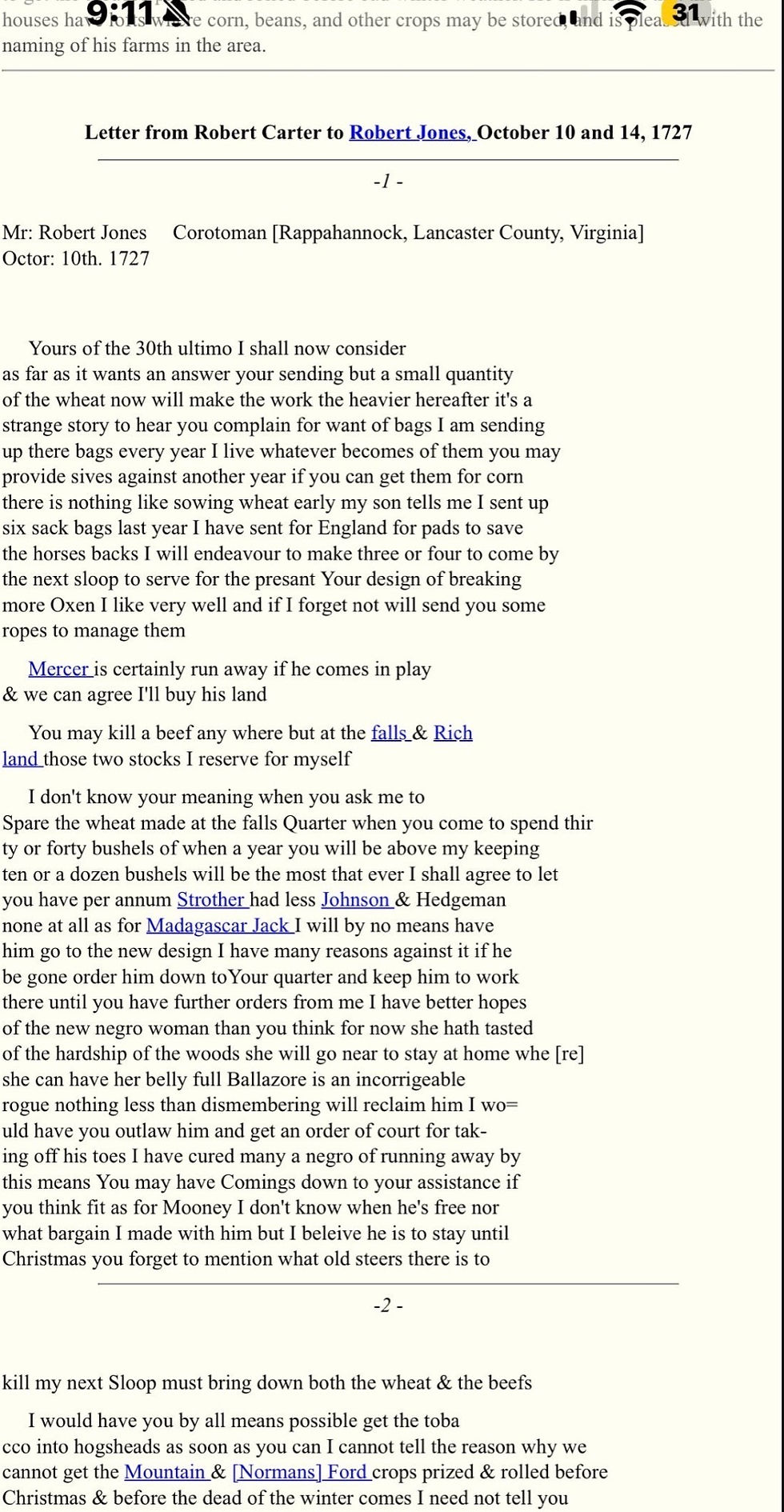
Munford served on the House of Burgesses with the Carters. This explains why there are DNA matches who descend from enslaved ancestors owned by the Carters, Burwells, Randolphs, Pages, and Byrds. These were families heavily involved in the Malagasy slave trade. In 1737, Col. William Eaton ( an Indian trader also documented on the Fort Christanna reservation ) took Robert Munford to court over a dispute tied to another Indian trader, Joseph Colson's estate. This same William Eaton was directly involved in a lawsuit against Edward Birchett for refusing to deliver enslaved Natives by the names of Patt & her children, Patt, Phebe, Hall, and Pompey. Interestingly, Phebe is the name of an Indigenous woman who was illegally enslaved by the Vaughan family, who also enslaved my Mitchell ancestors.
This history created a diverse lineage of West and Central African (Akan, Wolof, Mbundu, Igbo) and Malagasy descent. It also includes Native American ancestry, specifically from Algonquian, Iroquoian, Siouan, and Arawakan-speaking peoples. Finally, there is European heritage from English, Scots-Irish, and some distant Spanish roots, likely coming from Atlantic Creole ancestors.


It is important to note that DNA Timelines aren't as accurate for people who are multi-generationally mixed. There are African, Native, Malagasy, and European ancestors coming from multiple lines.
Generations of Resilience
In 1848, Parma married Samuel English in Gates County, North Carolina; he was also a Free Person of Color. Gates County, along with Hertford County (which includes the Winton Triangle), is where multiple multiracial Indigenous families lived. My Mitchell ancestors had blood relatives enslaved by the same Vaughan/Vann family in Murfreesboro, Hertford County, North Carolina. There are Indigenous families on both sides of the North Carolina/Virginia border; some relatives were free, and some were enslaved. Isle of Wight borders Southampton and Nansemond counties, which border Northampton, Hertford, and Gates counties in North Carolina.
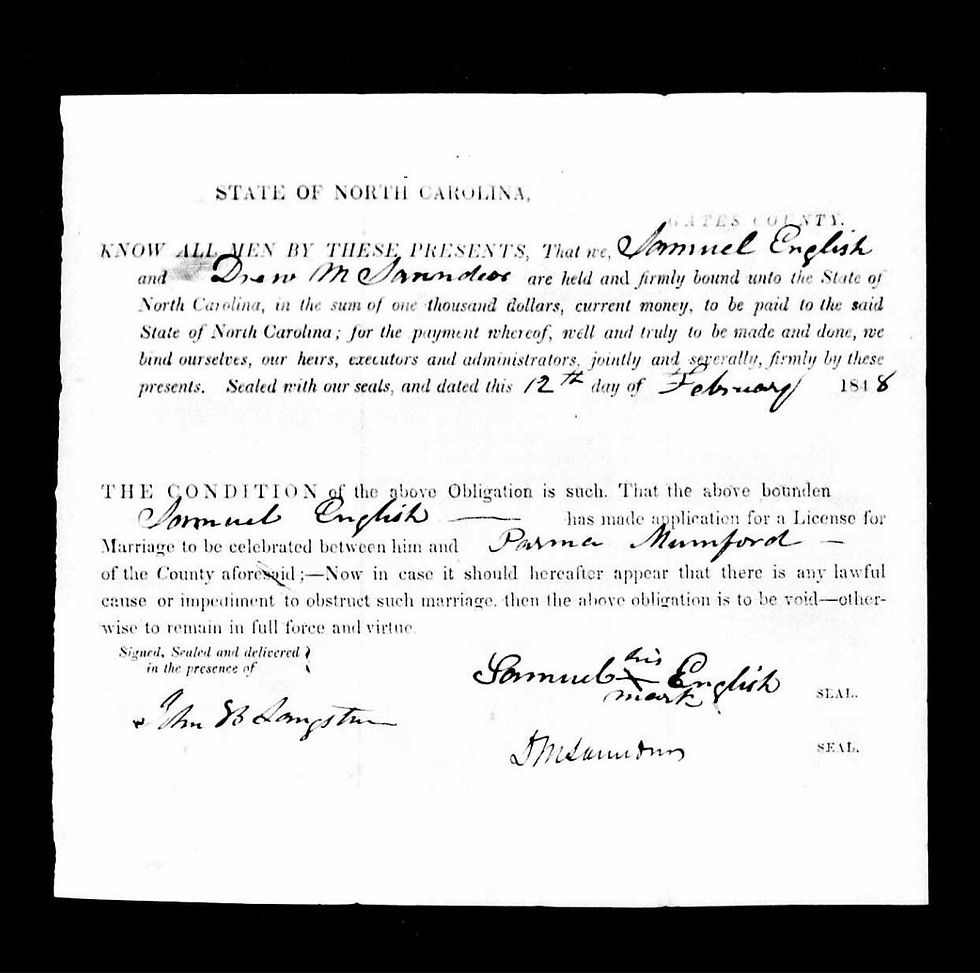
John B. Langston is listed on the marriage license as a witness. He could be either the clerk, a family friend, or a relative of Parma and Samuel. Drew Saunders was a bondsman; he likely was a family friend or relative as well. Both the Saunders and the Langston families in Gates, NC, are documented as marrying into the Cherokee Vann family. Langston is a surname for some Pamunkey families as well as some Meherrin. The Langstons, who were in Gates, NC, were originally in Nansemond County, Virginia, which is close to Isle of Wight. Vaughan/Vann is also a surname associated with the Meherrin tribe.
Watkins is also a family surname (could it be her mother's?) According to their son Spencer English's death certificate, Parma's maiden name is Watkins. The informant was Parma and Samuel's son, Samuel English Jr.


"By the late 18th century, in adherence with the idea that 'one drop' of African blood defined a person as black, white settlers advocated for the state to stop recognizing Indian identity (and tribal land ownership) on the idea that the Native American identity had been lost due to intimacy with Black Virginians. To wit, free Native Americans were classified on the census not as Indian but as free people of color or mulattoes." -Dr. Arica L. Coleman https://time.com/5141434/virginia-indian-recognition-pocahontas-exception/

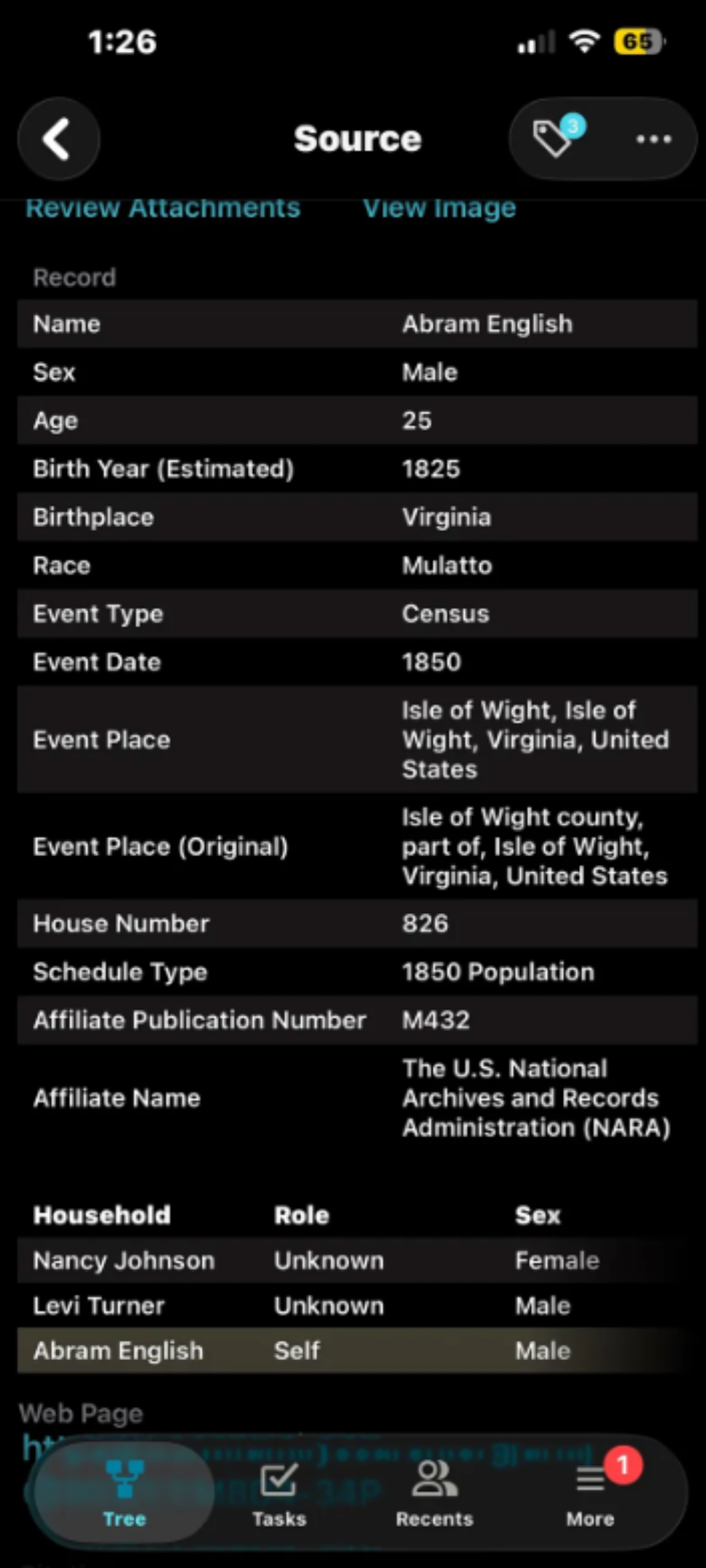
Next door, in the same year's census, is Abram/Abraham English (likely the brother of Samuel English). He is documented as a mulatto laborer living with two white people: Nancy Johnson (a farmer) and Levi Turner (another laborer). It is important to highlight that my ancestors also lived in the same neighborhood as other Native families and intermarried with them, such as the Bass, Artis, Hines, Turner, Woodson, Whiteheads, among others.
In 1825, Samuel, as a 7-year-old, is documented as being a mulatto farmer indentured to Ecom Eley. His mother is documented as Patsy English; there is no father listed in the indenture record. Patsy was likely a free Indian woman or a free woman of color with Native ancestry, which is why Samuel English was free because of his mother's status. Patsy isn't documented as having any daughters, so there are no direct female descendants to figure out her maternal haplogroup. It wasn't uncommon for Native children to be bound out to White colonists until the age of adulthood. English is also likely Patsy's maiden name.
The Library of Virginia states, "In 1785, the General Assembly transferred this responsibility to the Overseers of the Poor. Indentures of Apprenticeship within Virginia Untold are composed of agreements binding out free Black and multiracial individuals, often children, to learn a particular trade or craft."
These multiracial individuals included people like my ancestor, Samuel English, who was of mixed Native lineage.
"Indigenous people were indentured and enslaved in the Virginia colony. For example, to ensure treaty compliance and to promote assimilation, the English demanded that Indigenous children serve as indentured servants within English households. Ostensibly, these indentures offered the opportunity to convert Indigenous children to Christianity. Indigenous parents argued, however, that indentures funneled their children into the slave market.” - Encyclopedia Virginia https://encyclopediavirginia.org/entries/the-legal-status-and-classification-of-indigenous-people-in-virginia/


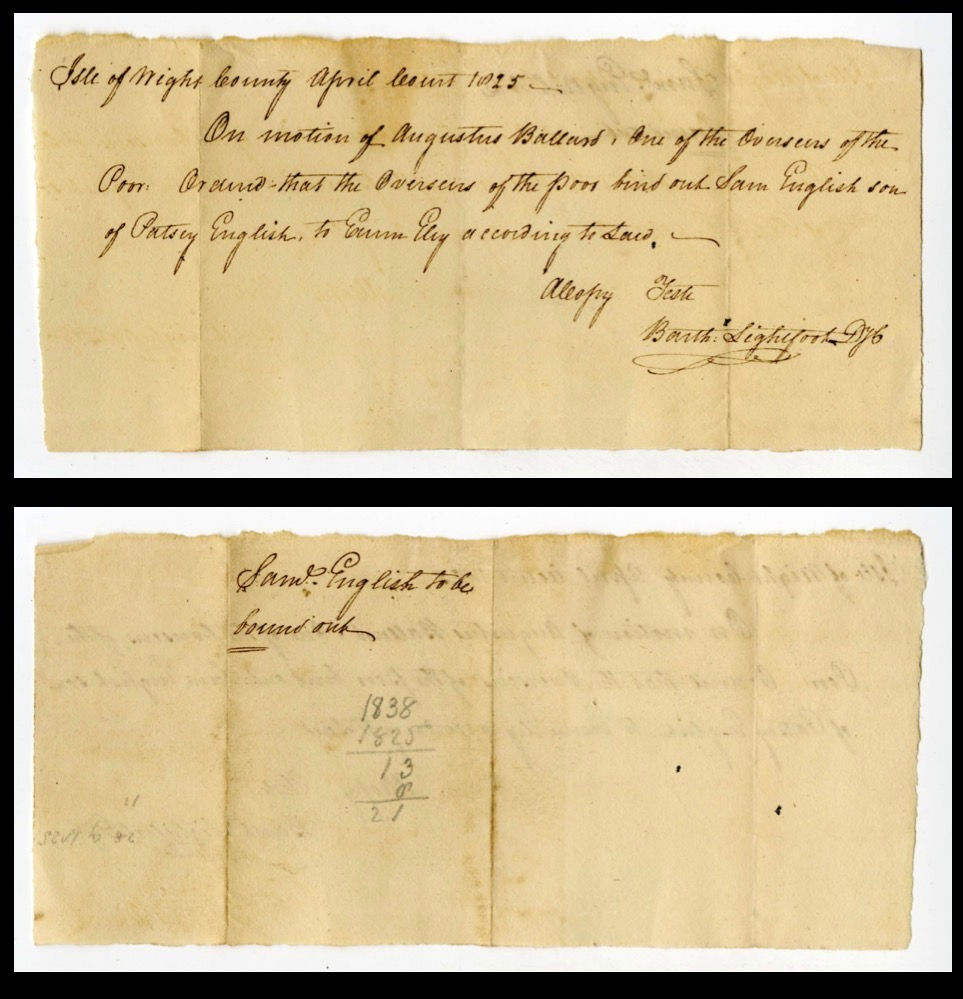
Transcription: "This Indenture made this 28th day of April in the year of our Lord 1825 Between Augustus Ballard and Jacob H. Duck Overseers of the Poor of Currywaugh District in the County of Isle of Wight of the one part and Eunn Ely of the County aforesaid of the other part Witnesseth that the said Augustus Ballard & Jacob H. Duck Overseers of the poor as aforesaid by virtue of an order of the Court of the aforesaid County bearing date April Court 1825 have put Placed and bound and by these presents doth put place and bind Sam a Mulatto Boy Son of Patsey English of the age of seven or eight years to be an apprentice with him the said Eunn Ely to dwell from the date of these presents untill the said Sam shall come to the age of twenty one years According to the Act of the General Assembly in that case made and provided by and during all which time and term the said Sam shall the said Eunn Ely his said Master well & faithfully serve in all such lawful business as the said Sam shall be put unto by his said Master and honestly and obediently in all things shall behave himself towards his said Master and honestly and orderly towards the rest of the family of the said Eunn Ely and the said Eunn Ely for himself his Executors and Administrators doth hereby promise & covenant to and with the said Overseers of the Poor and every of them & their and every of their Executors and Admrs their & every of their Successors for the time being and to and with the said Sam that he the said Eunn Ely shall the said Sam in the craft Mystery & Occupation of a Farmer which he the said Eunn Ely now useth after the best manner that he can or may teach instruct and inform or cause to be taught instructed & informed as much as thereunto belongeth or in any wise appertaineth and that the said Eunn Ely Shall also allow & find unto the said apprentice sufficient meat drink, apparel, washing Lodging and all other things needful for an apprentice during the Term aforesaid and will moreover pay to the said Sam the sum of twelve Dollars at the expiration of the aforesaid Term—In Witness whereof the Parties to these presents have hereunto set their hands and seals the day & year first herein written Signed sealed & acknowledged in presence of } Augustus Ballard [Seal]Jacob H. Duck [Seal]Eunn Ely [Seal]May 1825 File IndentureSam English Sam of English son of Patsey English bound bythe Overseers of the Poor to Indenture Eunn Ely Isle of Wight County April Court 1825— On motion of Augustus Ballard, one of the Overseers of the Poor Ordered that the Overseers of the poor bind out Sam English son of Patsey English to Eunn Ely according to law, A copy Teste James P. Lightfoot Clk Saml English to be bound out. "
Ecom Eley was also an indenture holder for a 17-year-old boy named Joe Johnson who was recorded as a Free Negro in the Indenture of Apprenticeship record.

Abraham English, at around 10 years old, is documented in the Isle of Wight Free Negro List of 1833. He is indentured to Thomas Marshall as an apprentice along with other Free People of Color such as Mach Turner, Bill Scott, Sam Nicks, Lucy Nicks, and Jacob Nicks. Instead of living with his mother, he, like his brother Samuel English, is living in white households as a worker. This means my ancestors didn't have much, if any, of a childhood, which is sad to think about.

Ecom Eley (the same person Samuel English was indentured to) is designated as an Overseer of the Poor. He is mentioned in the document of Thomas Marshall (the same person as Abraham English was indentured to) as having Amey Ricks, a "Free Negro" bound out to him.

Samuel and Abram's Potential Relative
In the 1825 indenture record, Patsey English is identified as Samuel English's mother. Samuel would also name his daughter Patsy/Patsey after his mother. Samuel's firstborn child and son is named John English. He is documented as a 3-year-old in the 1850 census living with his parents, Parma and Samuel. In 1817, a white man named John W. English from Isle of Wight County was found guilty of falsifying emancipation papers for an enslaved man named Miles (alias David Johnson) so he could pass as a free person of color. Miles was enslaved by Nathan Jenkins. This shows that there were White Virginians at the time who were opposed to slavery and took part in helping free enslaved people. Despite John English being referred to as a planter, his race/legal status is not mentioned in the court records.

A jury found John W. English guilty, and he was sentenced to 12 months in jail and fined $200 (approximately $5,007.82 today). It is unknown what happened to John English after this. This could also be explained by different courthouse fires and missing records. What is interesting is how Ecom Eley served as a justice on John English's case. Samuel English (his potential relative), just 8 years later, would be bound out to Ecom Eley. Patsey, being a free woman of color, wouldn't have been able to marry a white man with the surname English. This means that English was likely her maiden name.
Systemic Classism
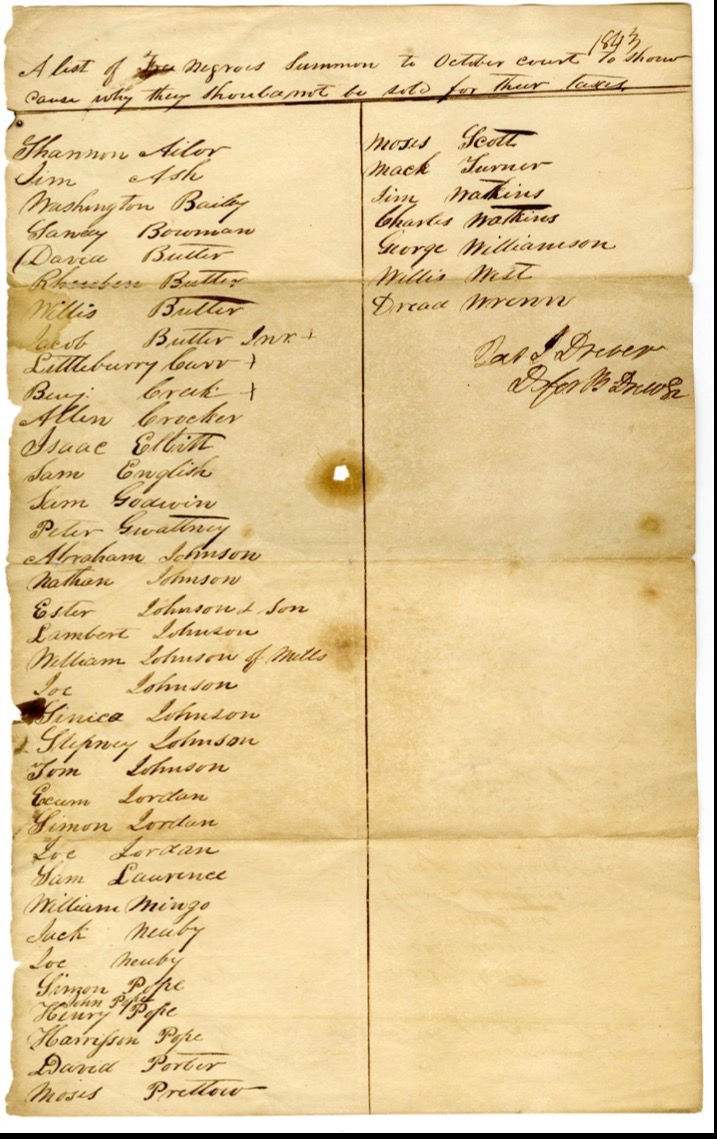
In the years 1841-1845, Samuel English, along with his brother Abram English (in 1844 and 1845), was summoned to court for failing to pay their taxes. Abram was summoned again in 1846. In 1841, Samuel English wrote a promissory note. I am not sure what is written in the note or even who he owed money to because the record is only available in person. What we do know is that he was likely not able to pay back the money he owed, which is why he was summoned back into court that same year. The Library of Virginia refers to Sam as a Black man, but in records during this time, he is documented as mulatto, meaning he was of multiracial ancestry, which includes African, European, and Native ancestry. The one-drop rule was not only rooted in the racist myth of white purity but also promoted hypo-descent (the belief that a multiracial child belonged to the marginalized racial group of their ancestry). This is why in my genealogical work, I ensure I am decolonizing and representing my ancestors properly to prevent any erasure.
During this time period, it was very hard for free people of color to meet systemically imposed financial obligations. Their taxes were higher than those of white Virginians. A lot of free people of color in Virginia lived in poverty and were not given the same financial opportunities as white people. Not paying taxes put them at constant risk of enslavement, effectively using the legal system as a tool to undermine their freedom. Abram English, in 1856, was hired out for not being able to pay his taxes. For families of Native descent, this financial persecution was often a deliberate strategy to displace them from their ancestral lands and erase their tribal identity by forcing them into the marginalized legal category of "free negroes” or “free mulattos.”
![Source: Samuel English in A list of Free [negroes] summoned to October Court 1841, 1841 (1186868_0003_0022). Virginia Untold: The African American Narrative Digital Collection, Library of Virginia, Richmond, Va](https://static.wixstatic.com/media/f64660_e92900ba7e1a41ce92dcf9cd63cd9563~mv2.jpeg/v1/fill/w_980,h_1567,al_c,q_85,usm_0.66_1.00_0.01,enc_avif,quality_auto/f64660_e92900ba7e1a41ce92dcf9cd63cd9563~mv2.jpeg)

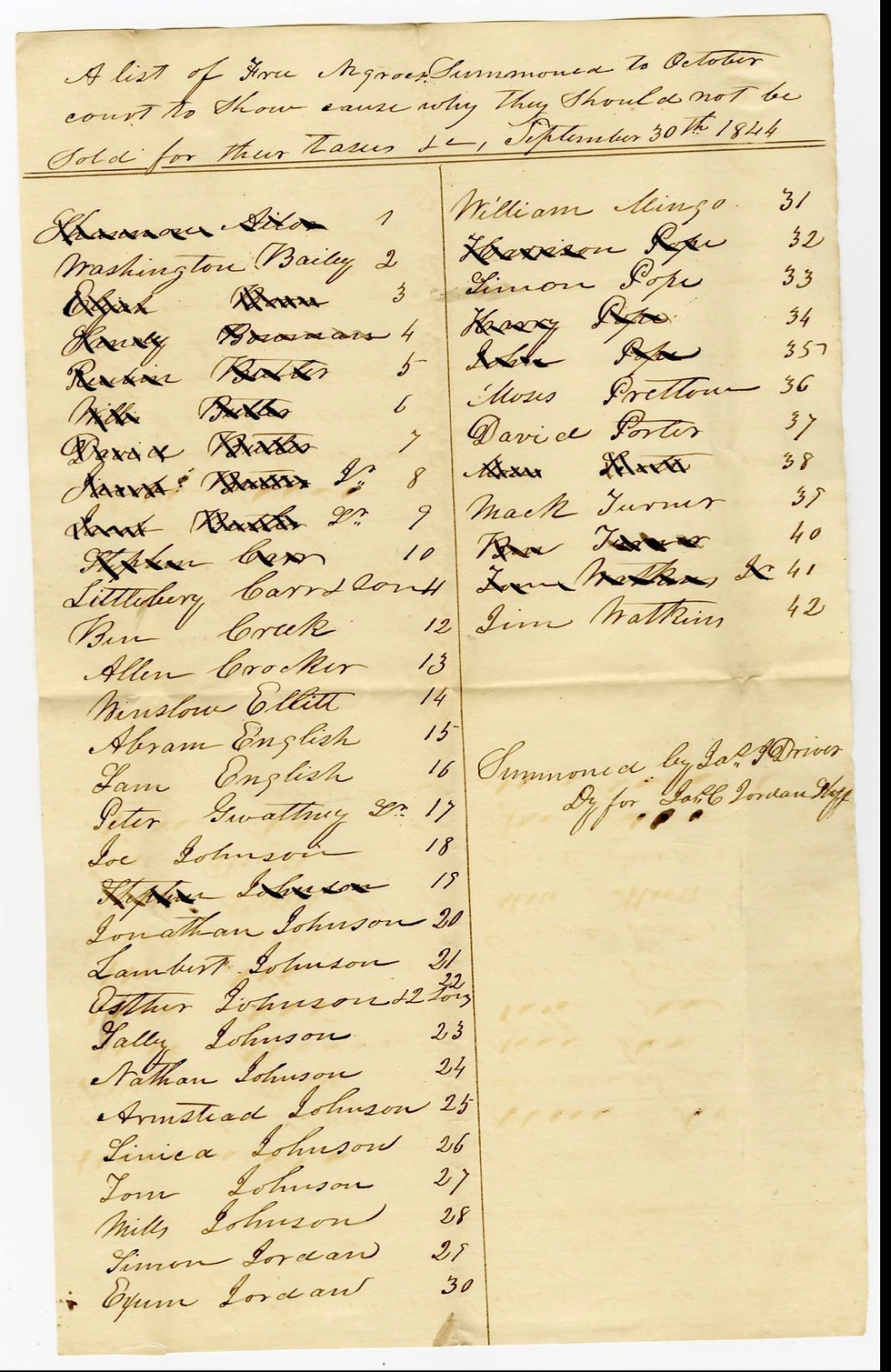

![Abram English in List of Insolvent Free Negroes [1858], 1858 (1186868_0003_0038). Virginia Untold: The African American Narrative Digital Collection, Library of Virginia, Richmond, Va.](https://static.wixstatic.com/media/f64660_85b9099e0b474c8bb2e8bcb5f5278357~mv2.jpeg/v1/fill/w_730,h_1134,al_c,q_85,enc_avif,quality_auto/f64660_85b9099e0b474c8bb2e8bcb5f5278357~mv2.jpeg)
![Abram English in List of free negroes to be hired out for taxes [1856], 1856 (1186868_0003_0036). Virginia Untold: The African American Narrative Digital Collection, Library of Virginia, Richmond, Va.](https://static.wixstatic.com/media/f64660_cb43bfe7cd7c4bf5b52510c37303cc27~mv2.png/v1/fill/w_980,h_1531,al_c,q_90,usm_0.66_1.00_0.01,enc_avif,quality_auto/f64660_cb43bfe7cd7c4bf5b52510c37303cc27~mv2.png)

Notice the names of other Indigenous people listed in the same records as my ancestors, such as Tom Mingo, Billy Mingo, Mack Turner, Joe Artis, Seneca Johnson, Washington Bailey, Jacob Key, Moses Key, Elisha Boon, Albert Canady, among others, including the Butcher family. One branch of the Native Butcher family was illegally enslaved by the same Vaughan family who enslaved my Mitchell ancestors. A network of families (of usually tri-racial: African, Native, and European descent) who belonged to the same Free People of Color community in Isle of Wight, Virginia, in which my ancestors were a part.
People of Native descent in Virginia who did not live on tribal reservations were referred to as Negroes and Mulattos in historical records. This was done purposely to erase Native identity and tribal affiliations to give white Virginians an excuse to continue stealing Native land and oppressing Indigenous people.
This erasure was often facilitated by the strategic use of taxes and social categorization; for example, white settlers, as seen in the case of the Accomack, frequently weaponized the intermarriage of Indigenous people with Black people to claim that tribes had "ceased to exist," thereby providing a pretext to seize reservation land. Once a tribe lost its official land base, the state stripped them of their status as Indians.
Even those who maintained cultural ties were often documented as "Mulatto" or "Negro" once they left a reservation or simply by the whim of officials, a practice that intensified under the later Racial Integrity Act to legally finalize the destruction of tribal identity. Unfortunately, this practice is still seen today when certain academic institutions continue to subscribe to the fallacy of a Black/White racial binary, a continuation of the racist one-drop rule.
“Despite White Virginians’ obsession with racial purity and strict anti-miscegenation statutes, such restrictions did not apply to the non-White population, which comprised Negroes, Indians, and mulattos among other groups. While the definitions of these categories would prove flexible over time and were not applied with any measurable consistency, the reality is that during the course of American and Virginian history, peoples of African, American Indian, or Afro-Indian descent, were included in these categories throughout the colonial period. Africans and American Indians freely intermarried and cohabitated since many shared a common lot as chattel slaves or free disenfranchised citizens. They also shared racial labels during the antebellum period as Virginia identified its nonwhite population with terms largely associated in contemporary American society with people of African descent such as Negro, mulatto, colored, free Negro, free person of color or Black.” — Pgs 64–65, That the Blood Stay Pure African Americans, Native Americans and the Predicament of Race and Identity in Virginia by Dr. Arica L. Coleman.
According to Encyclopedia Virginia, even tribal citizens of the Nottoway, Patawomeck, Accomack, Chickahominy, and even Pamunkey who still had their reservation land were documented in Free Negroes and Mulattos Registers.
Just to further illustrate the ridiculousness of the racial categories on the census, in the 1860 census Samuel (some transcribe wrongly as Lemuel) and Parma are documented as white; meanwhile, their children: Milton (George Milton English), Angelina English, Henry (William Henry English), and Benges/Burges (Burgess English) are documented as mulatto. John English isn't documented in this census or any census besides 1850. He could've passed away at a young age or was bound out (most likely he passed away because of the high childhood mortality rate). An Elijah Holland is living in their household, documented as Black. He could be a relative, considering Samuel and Parma are documented living on the same street as the Holland family.

In the 1870 and 1880 censuses, Parma and Samuel, along with their children, are documented as mulatto.
In the 1900 census, Parma and Samuel (along with their son Samuel English Jr., his wife, and daughter, who live next door to Parma and Samuel) are listed as Black. They have not been located in the 1890 census currently. It is important to note that Parma and Samuel are documented in the 1880 census as living in the same household as their grandchildren, Lucy Mays and Thomas Mays. The White Mays family in Virginia was known for enslaving Natives.


Spencer English (son of Samuel and Parma English) in the 1900 census is documented as Black, but in the 1910 census, he, along with his daughter Violet, are documented as mulatto.


Abraham English, along with his spouse and children, is documented as mulatto in the 1860 and 1870 censuses. In 1880, he is listed as Black, and he can't be found in the 1890 or 1900 census because he died on July 8, 1888.


On August 8, 1870, Samuel English is documented in the U.S. Selected Federal Census living in Windsor, Isle of Wight, Virginia. During this time, he owned 20 acres of land and 5 other unimproved acres. The cash value of his farm was $50. He had 100 bushels of Indian Corn. Despite white European settlers adopting corn as a universal grain, Samuel, belonging to an Afro-Native community in rural Virginia, likely preserved the traditional methods of processing it into cornmeal or even hominy.

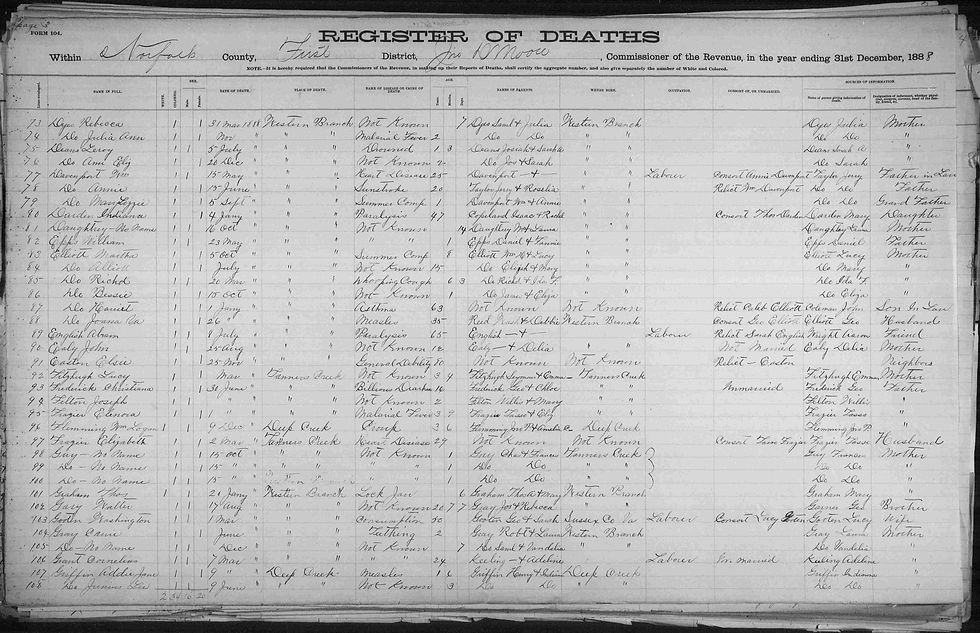
In the 1870 census, Frances Rogers (possibly Joseph Mitchell’s mother) is documented as a cook living in the household of John M. Holland, a white man. She is documented as living with other Black laborers such as Nathan Walker and John Joyner. Joseph Mitchell Jr. was around 8 years old at the time and was likely living with extended family. I can’t find him or his father in the 1870 census. Frances was likely unable to bring Joseph with her because white employers usually didn’t allow it. The Hollands weren’t against child labor because they had an 8-year-old named Alice working for them as a laborer at this time.

Frances was likely mistreated like other women of color during this time.
“Relationships between Black domestics and their white employers could be challenging to navigate. This was especially true in the South, where Black domestics often performed the same household duties they did during slavery. White employers took advantage of their Black workers by paying them poorly and treating them harshly. In addition, Black women often faced sexual harassment. Freedom from enslavement, however, empowered some Black women to stand up for better working conditions. Others decided to leave the South and move to northern states in search of better employers.” https://wams.nyhistory.org/primary-source/laundry-workers-strike/.
It is important to note that just because she is labeled as Black in this census record doesn’t mean she only had African ancestry. As seen in Frances' son, this erasure also occurred with my Mitchell ancestors, who were recorded as different racial designations on the census. Before 1900, Joseph, his wife, and his children are documented as colored in different birth records. In the 1900 census, he and his children are listed as Black. In the 1920 census, Joseph Mitchell, Martha Parker, and his children are documented as mulatto. His children, who lived in their own households, were documented differently. His daughter, Gertie Mitchell (married name Stokes), is documented as mulatto, while her husband and children are documented as Black. His son James C Mitchell (my 2nd great-grandfather) was documented as Black. In the 1910 census, along with his wife and children are listed as Black. In the 1930 census, he is listed as Negro along with his children. In the 1950 census, he is documented as negro living in the household of his child. He would not be in the 1960 census because he died on March 11, 1952.


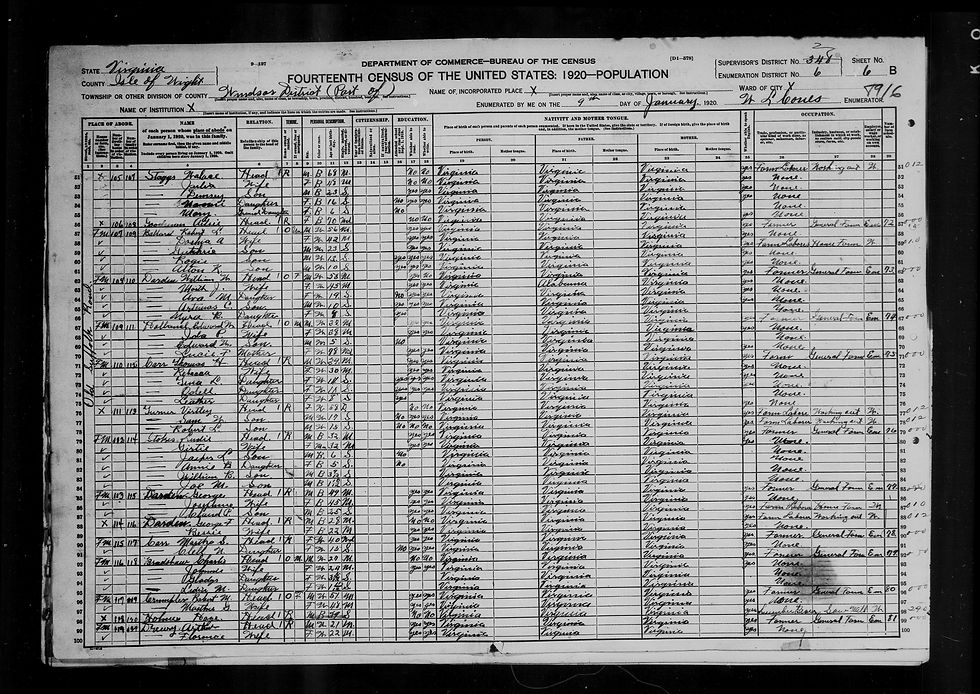

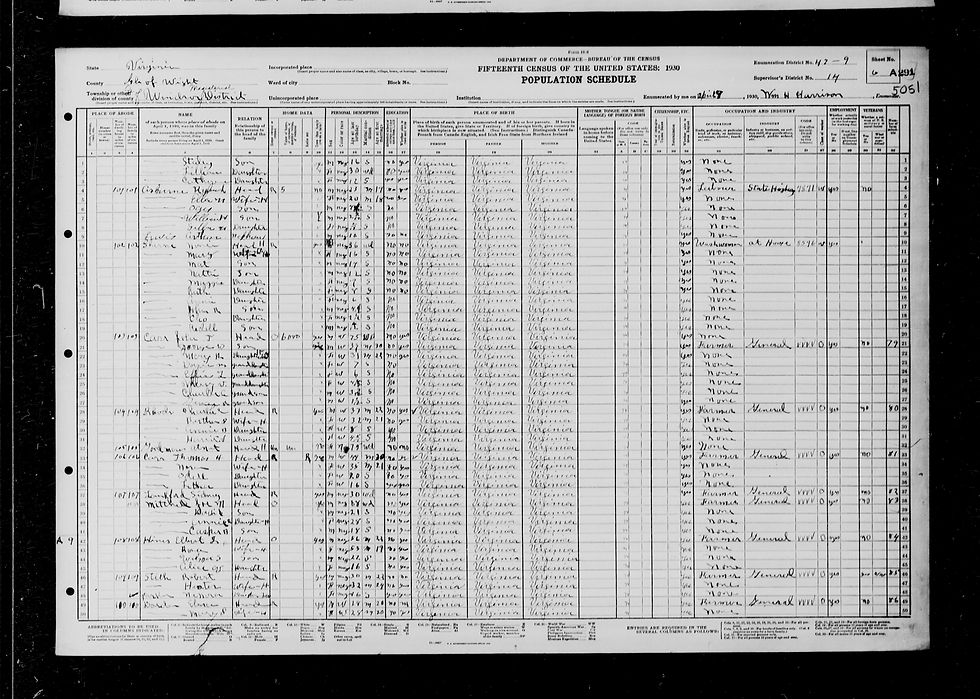

This is why it is important not to rely on racial designations on the census, because for Indigenous families, the designations were constantly shifting.
" In 1900, there were no specified categories on the census listing form, but the instructions called for enumerators to list “W” for white, “B” for “black (or negro or negro descent)”, “Ch” for Chinese, “Jp” for Japanese, or “In” for Indian “as the case may be.” There was no mention of “quadroon” or “octoroon.” This appears to be the first appearance of “negro” (lower case) in the instructions but it was not listed on the form itself,” — Pew Research center
In certain years (such as the 1900 census), there were only monoracial categories on the census, erasing my ancestors who were multiracial. There wasn't a tri-racial category on the census, such as triguena/trigueno in Latin America, causing multiracial Indigenous people to be erased. This displays the clear paper genocide that occurred.

Different Branches from the Same Root
Parma and Samuel's daughter, my 3rd great-grandmother Julia English, was born in 1869 in Isle of Wight, Virginia. Julia carried the traditions of her ancestors; she was known by descendants as being of Native descent. She is remembered by descendants of wearing a medicine bag filled with natural herbs.
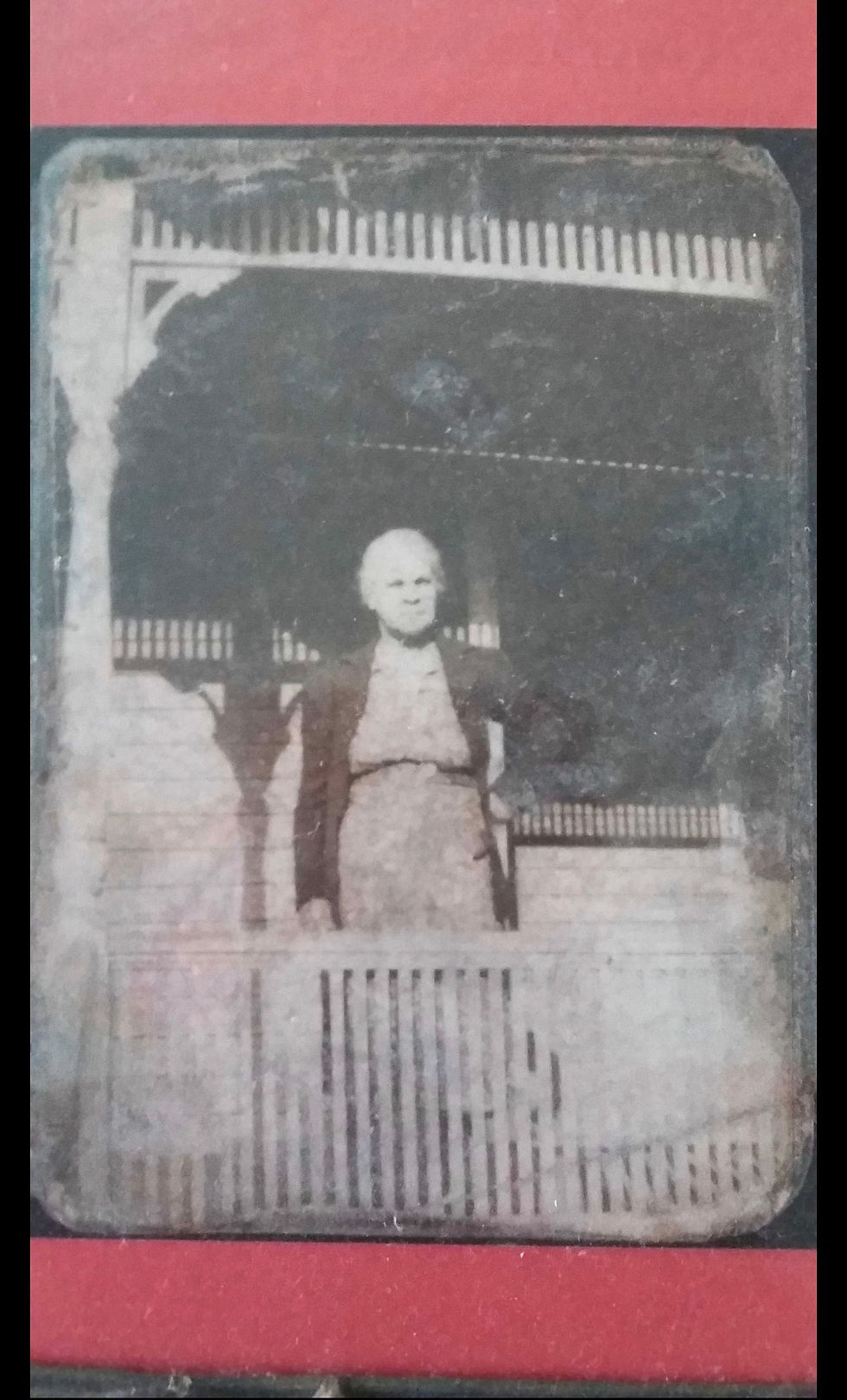
In 1887, Julia married Wallace Staggs, a man of primarily African descent born in Southampton. Due to the ban on interracial marriages, wanting to escape the anti-black/anti-native Jim Crow South, and better financial opportunities, the family eventually decided to leave Virginia for East Orange, New Jersey. Julia and Wallace could've been mistaken for an interracial couple, which could put them in harm's way staying down south.

Their daughter, Cora, later married James Claudius Mitchell in 1909.

James Mitchell is the son of Joseph Mitchell Jr. and Martha Parker, and the grandson of Joseph Mitchell Sr. and Frances Walden/Rodgers.
Unfortunately, on November 2, 1955, tragedy struck. My ancestor James Mitchell was a workman helping to construct Cornell University when he was caved in and passed away.

My ancestors made the difficult choice to leave their ancestral homelands in pursuit of a better life. It saddens me to know that James Mitchell was working very hard to provide for his family just to pass away during his shift.
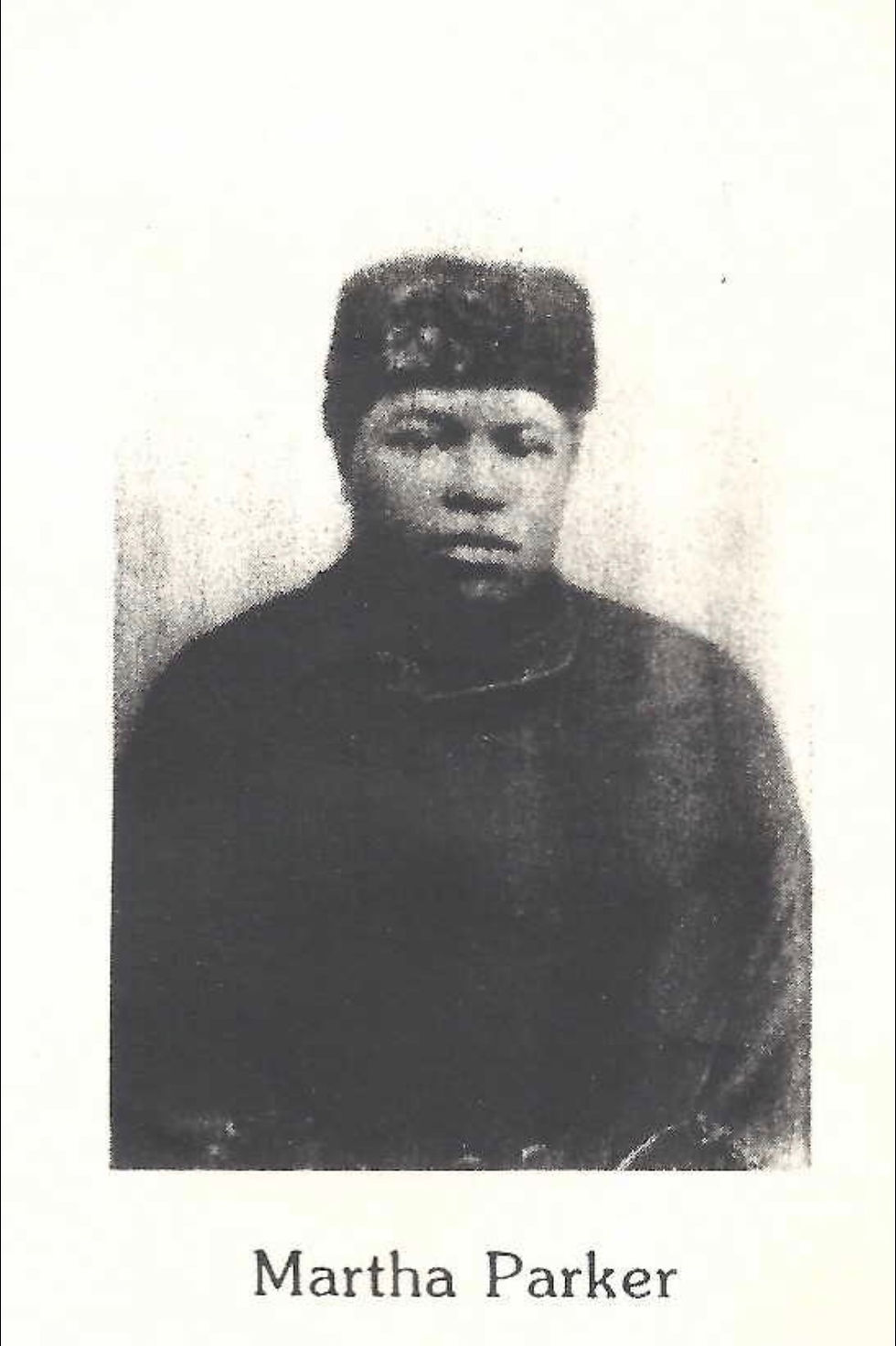


Joseph and my ancestor Samuel English (who married Parma Mumford) descend from enslaved African and Native ancestors who came together in James City County, Virginia, Isle of Wight, Virginia, and Surry County, Virginia, to resist slavery. The English family's connection to the slave conspiracy will be discussed in the next section.
My Indigenous ancestors are from Corrowaugh/Carrawaugh (known today as Windsor) within Tscenacommacah. Parma and Samuel's daughter, Martha "Patsy" English (married name Scott), moved from Corrowaugh to Chuckatuck. My Yesah Occaneechi Hayes and Yesah Munford/Mumford ancestors are from Akų:čuk within Amanishuck (the Indigenous name of the North Carolina and Virginia Piedmont). The Fort Christanna reservation land in Brunswick, Virginia, is located within Jungatapurse (horse's head), a Saponi village.
It is likely Joseph's Native ancestors were remnants of the Nansemond tribes who got absorbed into the Nottoway tribe in the 18th century and somehow ended up being enslaved.
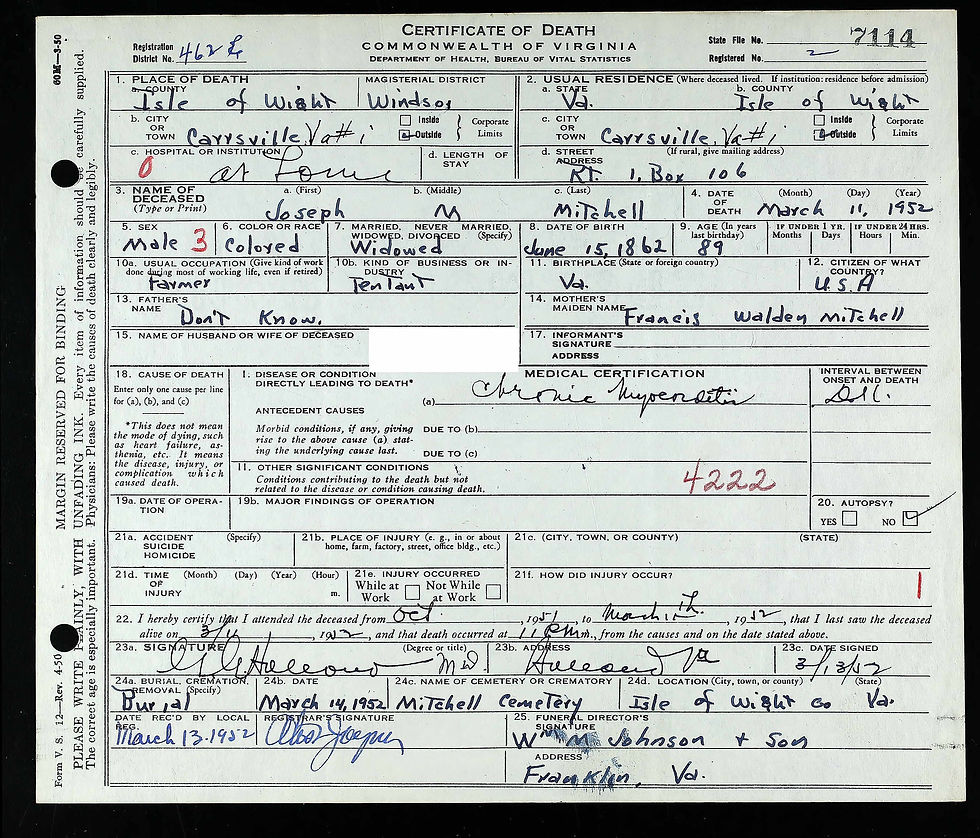
On Joseph Mitchell's death certificate, his mother is listed as Francis Walden Mitchell. Walden is inferred to be her maiden name. There is a Walden Free Person of Color family in Virginia associated with the Nottoway tribe.
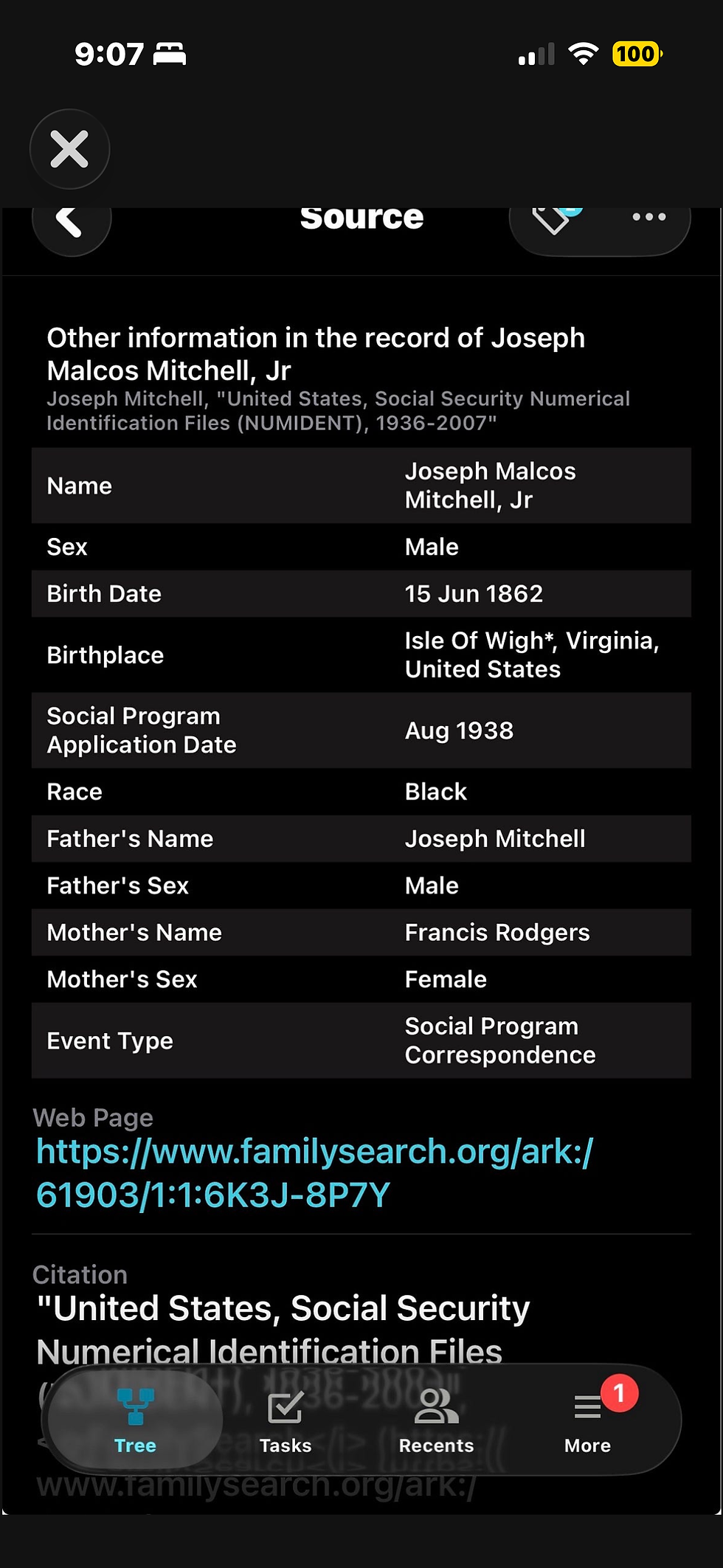
In 1939, Joseph Mitchell submitted a social security application, documenting his father as Joseph Mitchell Sr. and his mother as Francis Rogers. In the 1808 Nottoway Indian census, a Nansemond woman named Celia Rogers is documented living on the Nottoway reservation. Rogers/Rodgers is a shared surname of Joseph's mother. The Indigenous peoples of Isle of Wight are the Nansemond, Nottoway, and Warraskoyack. The Quiyoughcohannock are Indigenous to Surry.
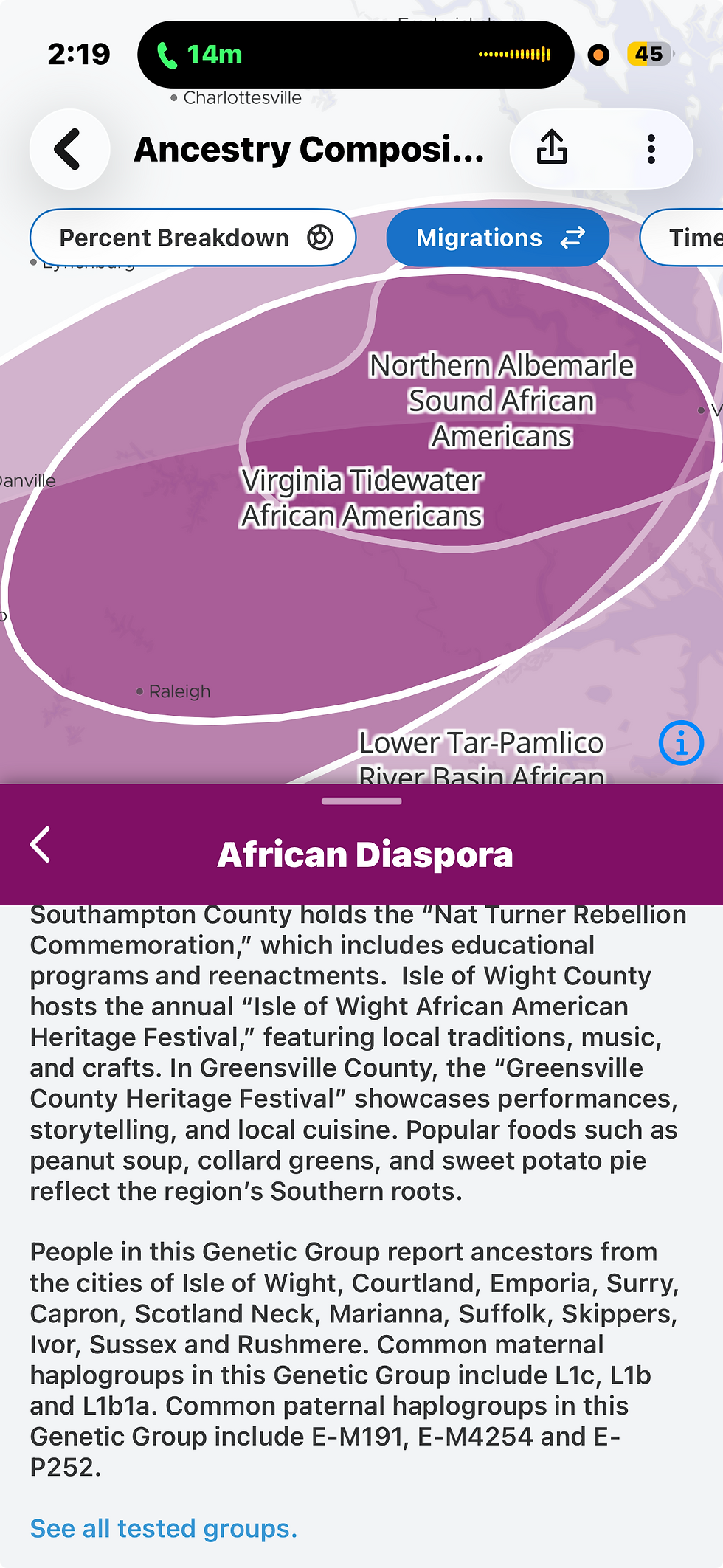

“The acts of 1691 and 1705 did nothing to put an end to Indian slavery in Virginia during the colonial period. A 1709 slave conspiracy provides indisputable evidence of the continued enslavement of American Indians in Virginia. Early 1709, authorities discovered a slave plot organized by Negro and Indian slaves in the counties of James City, Surry, and Isle of Wight. On March 24, 1709, an investigation led by the Governor in Council found that, ‘a Late Dangerous Conspiracy formed and carried on by greater numbers of ye said negroes and Indians slaves for making their Escape by force from ye Service of their masters, and for ye Destroying and cutting off Such of her Majesties Subjects as Should oppose their Design.’ By the conclusion of the investigation, numerous doves had been ‘punished and Discharged’; however, the three men believed to be the lead conspirators, Scipio, Salvador, and Tom Shaw remained confined. A fourth conspirator, Peter, remained at large and eluded capture for at least a year. The final fate of the men remains unknown.” -Pgs 74— 75, That the Blood Stay Pure African Americans, Native Americans and the Predicament of Race and Identity in Virginia by Dr. Arica L. Coleman.”

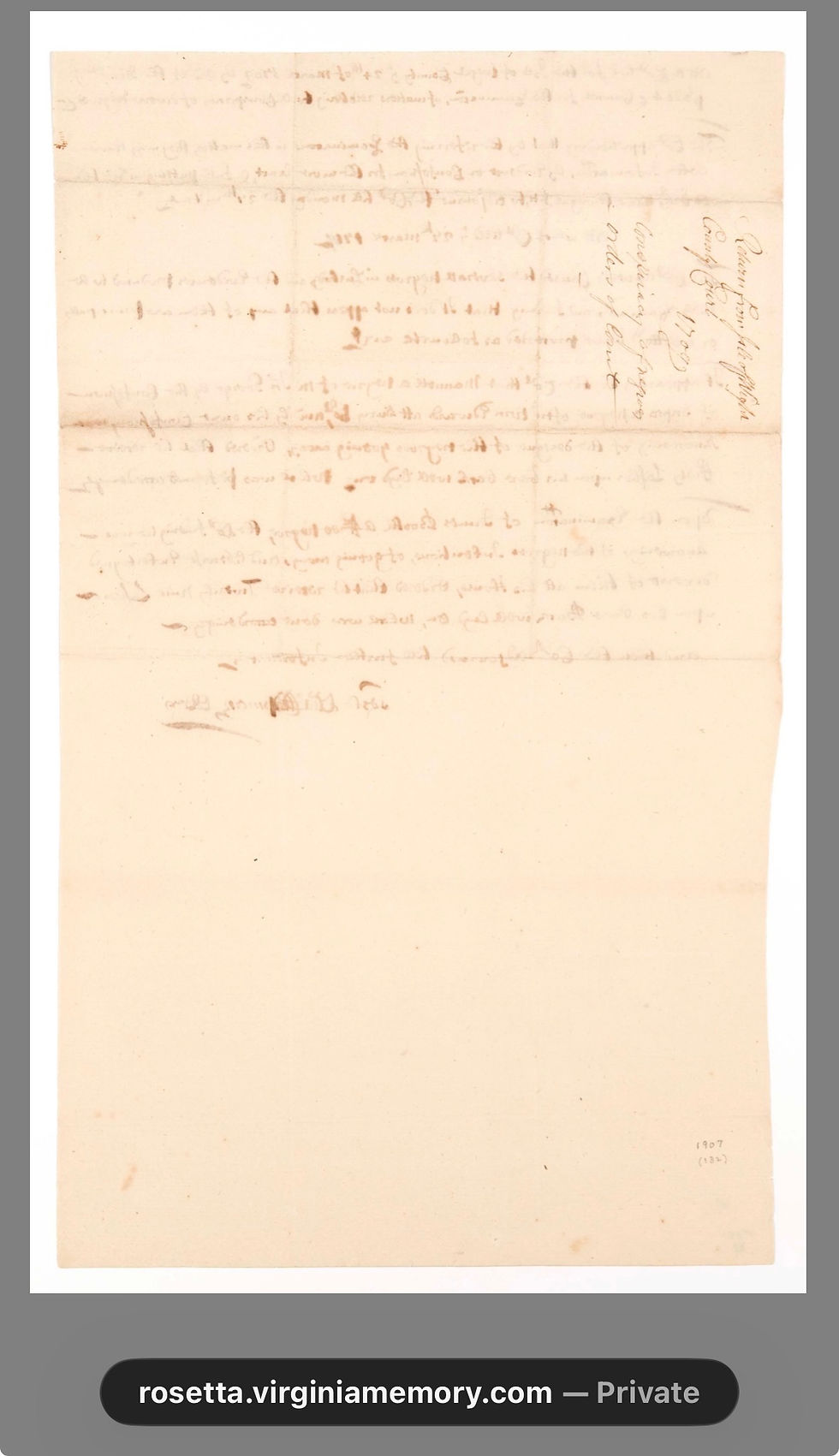

Origin of the Surname English
The oldest likely ancestors bearing the English surname are seen in the late 1600's to early 1700's as tithables in Surry County, Virginia. Their names are John English, Tom English, Robert Rammorter English, Betty English, and Edward Parrott-English.
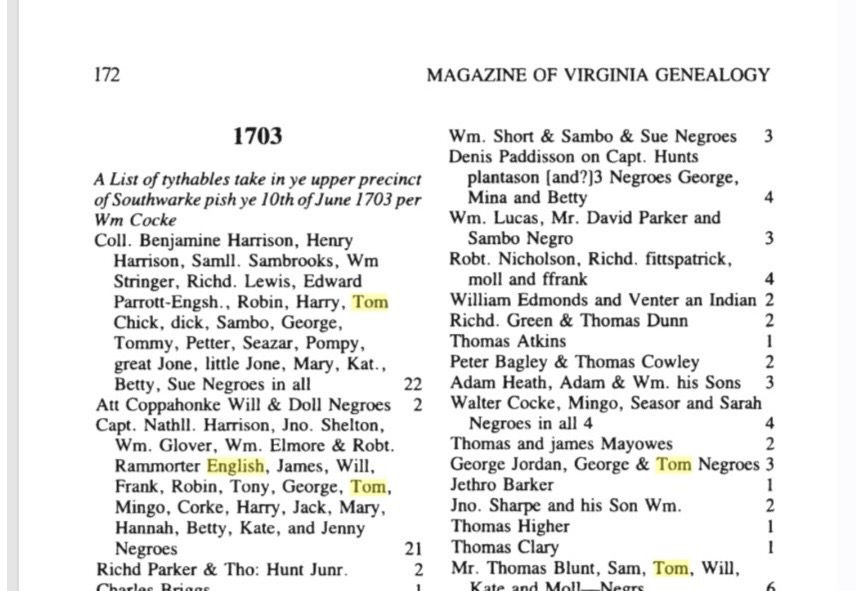
Rammorter could be an anglicized version of Ramotar, which has roots in the Indian subcontinent. There were East Indian indentured servants in Virginia during this time; Robert Rammorter English could be one of them. It is unlikely that it derives from the English Rammorter family because there are no families documented in Surry, Virginia, during this time period that I could find with that name. It is possible Rammorter could be a corrupted African or possibly an Algonquian name as well. A linguist would have to confirm to be sure. He is in the same household as Mingo (a Spanish name and name for a Native tribe), among others.
Notice that there are people in the same household as Edward Parrot-English named Tom Chick (could be short for a broad Indigenous name, or from the white Chick family), Sambo (a name of West African origin), Great Jone, and Little Jone in the same household as Edward Parrott-English. Great Jone and Little Jone could be Indigenous names translated into the English language.
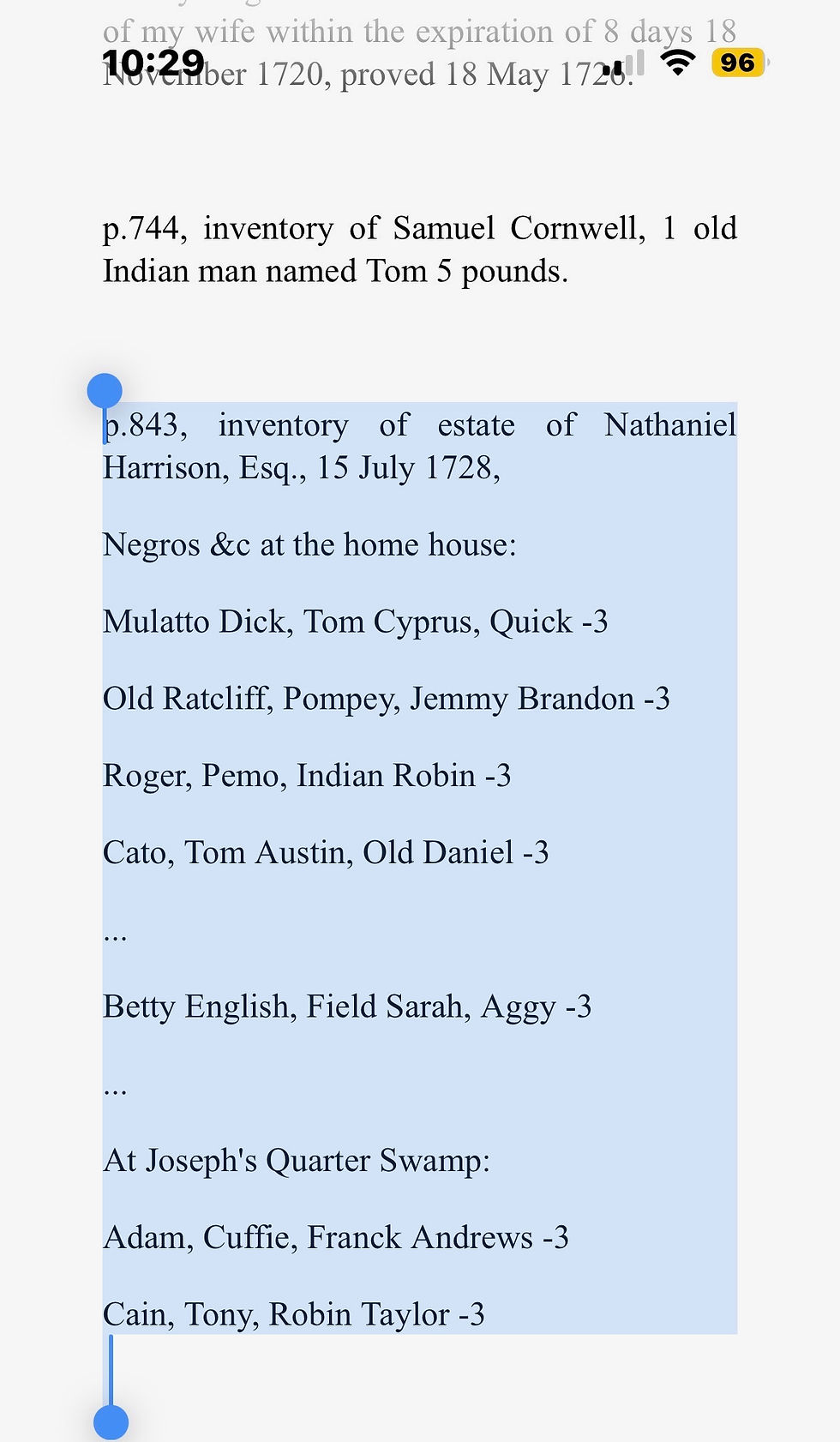
The English family's tribal origins could be Weyanoke or Quiyoughcohannock. Benjamin Harrison (whom Robert Rammorter English is listed as a tithable in his household) was responsible for housing Weynoke in the late 1600's.
"However twice in the 1660s and once in the 1680s, the Weyanoke were taken into the English towns in Surry Co, to seek safety. Colonel Benjamin Harrison II (1645-1712) was responsible for sheltering the Weyanoke and in 1667, the tribe had set up their cabins in his plantation fields. (See Binford, Lewis. An Ethnohistory of the Nottoway, Meherrin and Weanock Indians of Southeastern Virginia. 1967, for a comprehensive history of the Weyanoke tribe during the 17th century). Interestingly, Benjamin Harrison’s family is connected through numerous primary source records to the Gibson/Evans family. Morris Evans (husband of Jane Gibson the younger) owed a debt to Benjamin Harrison’s son Colonel Nathaniel Harrison according to the account books submitted to the court in 1727 (Surry Co Deed and Will Book 8: 320).”- https://nativeamericanroots.wordpress.com/tag/surry-county/
Thomas Kersey was a Weyanoke Native who was bound out to Benjamin Harrison. The Harrison family was Indian traders (including Benjamin Harrison) who traded with tribes such as the Nottoway, Weyanoke, Meherrin, and Saponi.
Initially, John English is listed as a tithable in the household of Elizabeth Caufield in 1693. After 1693, we do not see him listed, meaning he likely died. In the year before 1692, Tom English is listed as a tithable. From 1692-1700, he is listed as a tithable in Elizabeth Caufield's household and then her husband, Joseph John Jackman's household. In the year 1700, Tom English is documented as mulatto in the household of Joseph John Jackman. Mulatto (a term used for people of mixed native ancestry at the time) and, in multiple years, as living in the same household as Tom the Indian. Tom English is documented as living in the same household as a person named Cherino/Cherinoe, which is a Spanish name. The tithables who were living in the household were documented as Negro.
Mrs.Caufield was involved in a court case where she complained about John Page trading and trucking with her servants without her permission. John Page is documented as transporting multiple Indigenous people around the colony.
“On 22 April 1691, Davis took up an Indian man in Isle of Wight belonging to Roger Tilman of Charles City. Indian more than 10 miles from master. According to Mrs. Eliza. Caufield, John Page conducted "tradeing and trucking with her servants contrary to Law" and that she be paid 4 times the value of the items - 500 lbs. of tobo. She wants Page to be imprisoned for 1 month according to the 105th Act & give bond. Page pleaded not guilty, but court agreed with Caufield. Jury's verdict: value of goods was actually 50 Ibs. of tobo. His ferryman carried 9 Waynoake Indians to James City & back and also 5 Maherin & 10 Appamattock Indians to James City & back.”- Haun 1991:26-27 John Page & Mrs. Eliza. Caufield Complaint 4 Jan. 1692 court
It is important to note that even Natives were documented as Negro during this time period. For example, John Kiquotan (his Indigenous surname derived from the Kikotan/Kecoughtan tribe) is counted as a negro a tithable in the household of William Edwards.


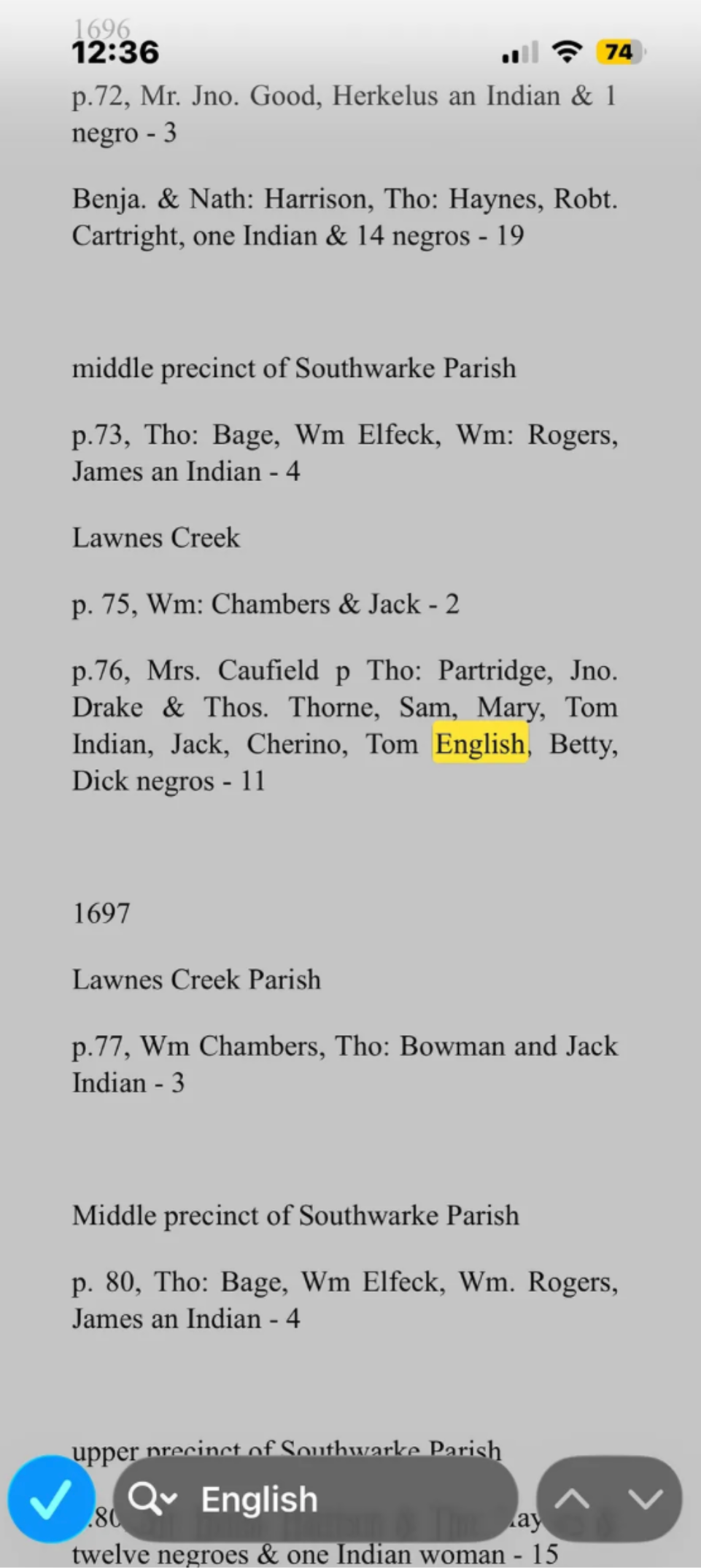
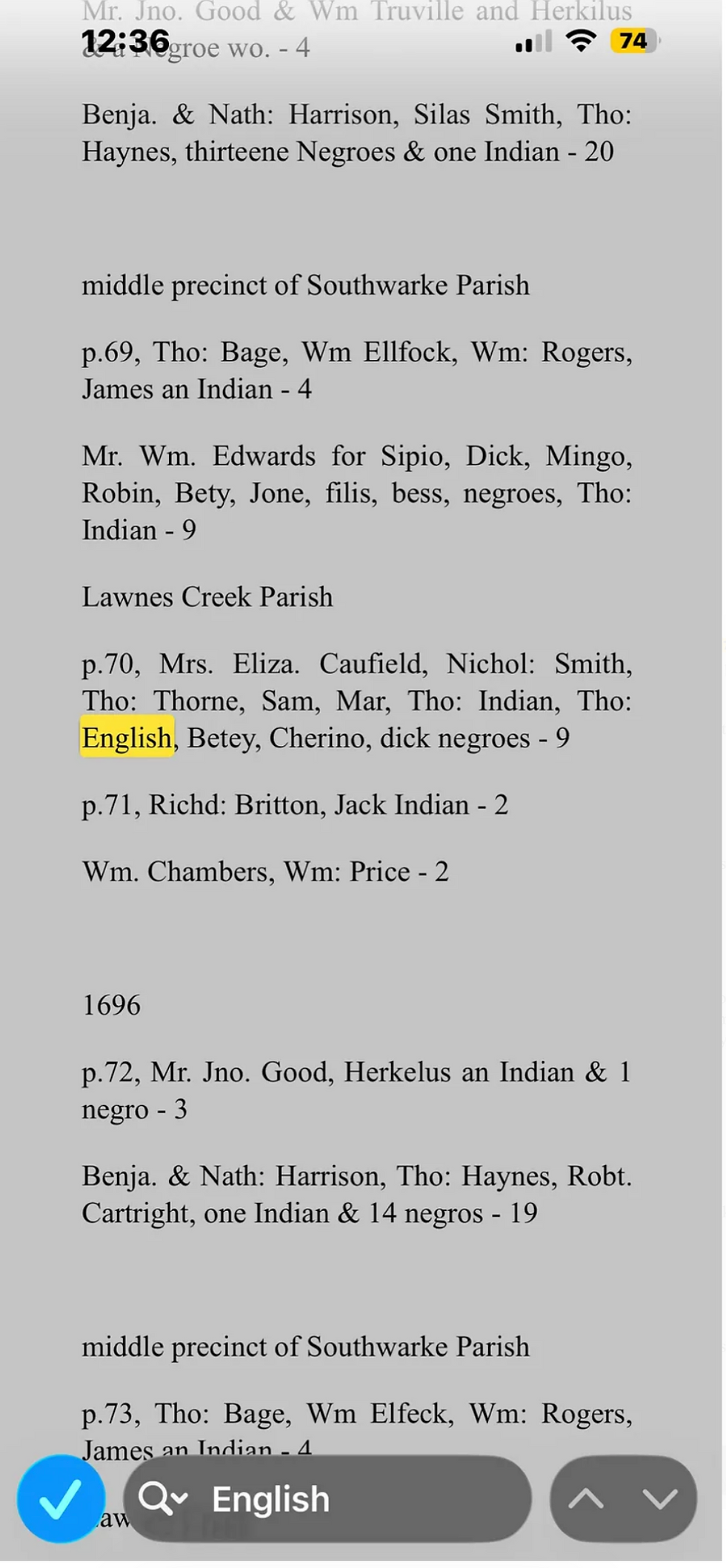
Also, when Tom English, along with the other people owned by Elizabeth Caufield, is transferred to her husband Joseph John Jackman, Tom Indian is included on the list of negroes. We know Elizabeth inherited enslaved people from her deceased husband, Robert Caufield. Mr. Caufield also owned other Natives, such as Thomas Busby, Tom Indian, and Jacob.


Elizabeth Caufield (maiden name Allen) comes from a large enslaver family that also purchased enslaved people from Barbados, and even had the same Jacobean house structures as plantations in Barbados. It is important to note that a significant number of Malagasy were enslaved in Barbados, and there were some Indigenous people enslaved alongside Africans during the Indian slave trade.
"In April 1681, two agents of the Royal African Company at Barbados reported that between 900 and 1,000 Malagasy had been imported in the island in two months, with severe economic damage to the Company's monopoly (See, Donnan 1930-35:549). Sir Richard Dutton, Governor of the colony, in June 1681, confirmed the account declaring that many Blacks brought to Barbados had indeed come from Madagascar." Pgs 596-597, Chapter 35, Slaving in Madagascar: English and Colonial Voyages in the Second Half of the 17th Century AD, Liliana Mosca

Robert Caufield is documented (along with the aforementioned Allens) as purchasing enslaved people from Barbados. A lot of the enslaved people were being brought to the colonies from the Caribbean rather than directly from Africa during this time period.


My dad's 23andMe results: This explains why my dad gets Barbados (more specifically Saint Michaels) as a county match due to this line and other lines that start off in the Caribbean. In the same household as well as neighborhood, we see Natives, White servants, Africans, East Indians, and multiracial people living together. They were also having relations with each other. English was likely used as a descriptive term (or adopted from the White English family who lived in the region). There is a possibility that there could be blood ties to the White English family as well. Later on was adopted by descendants as a surname once they were manumitted or served their indenture. This explains why my English ancestors (likely direct descendants of the aforementioned Englishes) were free in the late 1700's to 1800's, pre-emancipation in Isle of Wight, which borders Surry. There were some Weyanoke who ended up in North Carolina in Tuscarora territory, and there was a Jemmy Wineoak documented in the 1808 Nottoway Reservation census, living in Southampton, Virginia, which borders Isle of Wight County. This could also explain why Samuel and Parma chose to get married in Gates, NC, instead of Isle of Wight, Virginia. They likely had kin who lived there. The Blackwater River flows through Surry, Sussex, Isle of Wight, and Southampton counties. It seems like my ancestors were following the river's path.
Surry County, alongside Isle of Wight County, is where the Native and African slave conspiracy took place in 1709, which was referenced earlier in this article. Notice, one of the Native people involved in the conspiracy is named Salvadore. He was owned by Joseph John Jackman, who is the second husband of Elizabeth Caufield. Remember, Jackman also inherited enslaved people from his wife, Elizabeth. His name is Salvadore, showing he likely originated from the Spanish Caribbean, which would explain why English/Mumford descendants share DNA with ancient Indigenous Caribbean remains such as Atunwa Inaru and living relatives who either currently live in Puerto Rico, aka Boriken, Dominican Republic, aka Quiskeya, and Cuba. For some descendants, Mesoamerican Native ethnicities or Caribbean Indigenous ethnicities show up on DNA tests.
The Mitchells and the Vaughan Traders
The Mitchells were enslaved by the aforementioned Vaughans, who were also "Indian traders" and owned both African and Native people. Relatives of the Mitchells, who were enslaved by the Vaughans, provided testimony in court records, stating they were being illegally enslaved because they were Indigenous.

Nicolas Vaughan (son of William Vaughan) had two sons named Robert Vaughan and Abraham Vaughan, who were Indian interpreters for the Catawba Nation under King Hagler.
!["George Washington mentioning Robert Vaughan and his brother Abraham Vaughan dated 15 March 1757 Read further advised Washington that about five days after the first party arrived, a larger group of 93 Catawba arrived at his house in Lunenburg including their Chief “King Haglar.”[5] A smaller group including the chief were going to Williamsburg while the rest were going to Winchester to see Washington. Read wrote “as their Numbers were great, the Country thro’ which they were to pass thinly Inhabited, and as the Frontiers might be frightned at such an Appearance of Painted Indians, I deem’d it necessary to send a White Man along with them, And as Robert Vaughan was gone with thee first 26, and as the Nation seem’d very fond of him, I thought I might please them in sending his Brother Abraham Vaughan with these to you, and they seem’d pleas’d that I did.”https://asonofvirginia.blog/2024/09/24/brothers-robert-vaughan-and-abraham-vaughan-french-and-indian-war-interpreters-and-guides/](https://static.wixstatic.com/media/f64660_a851762d77024cb99503092f663426ac~mv2.jpeg/v1/fill/w_980,h_1663,al_c,q_85,usm_0.66_1.00_0.01,enc_avif,quality_auto/f64660_a851762d77024cb99503092f663426ac~mv2.jpeg)
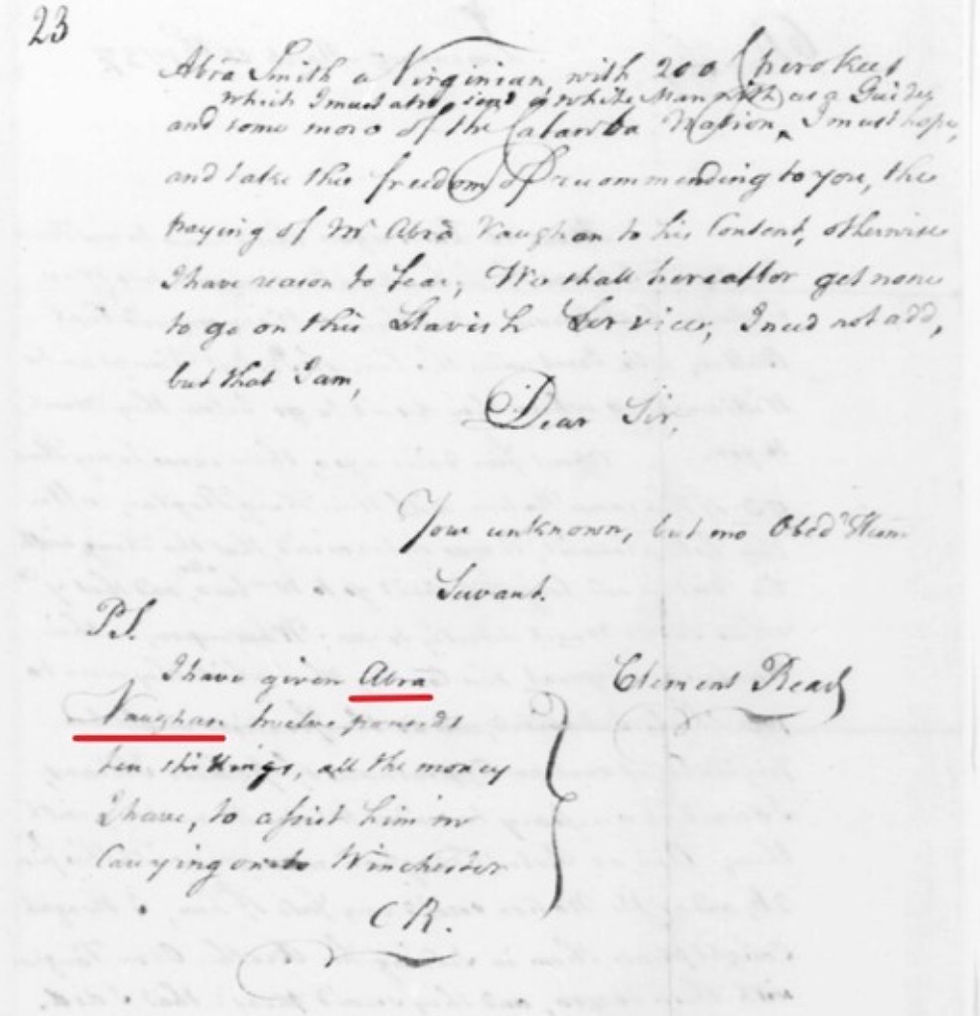
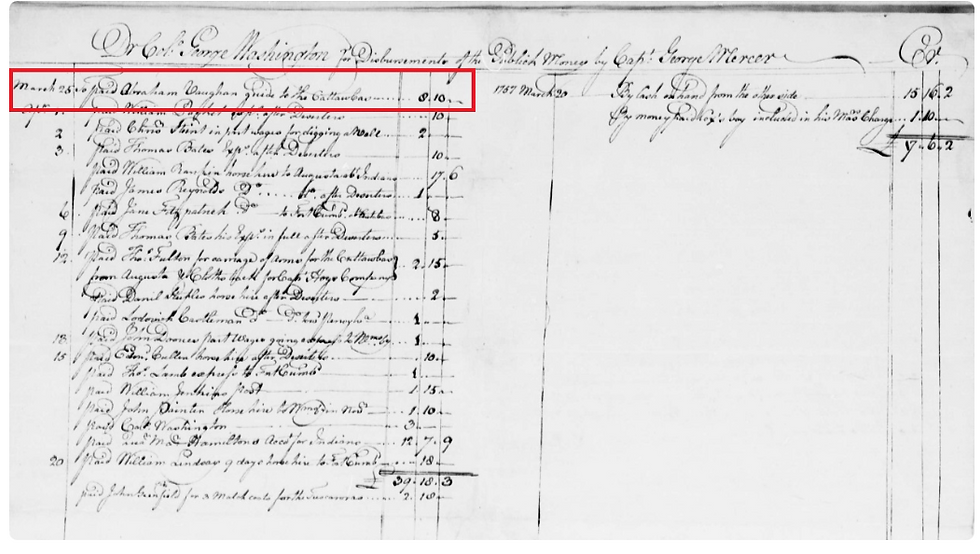

The Vaughans were business associates of other enslavers of Native people, such as Colonel Robert Bolling and John Evans. Robert Bolling was married to Jane Rolfe, the granddaughter of the historical figure, Pocahontas (Matoaka). Robert Mumford's son James Mumford married Elizabeth Bolling, the granddaughter of Robert Bolling and his second wife Anne Stith.

Because the Mitchells refused to take the Vaughan name, the Vaughans refused to grant them land. According to family oral history, Joseph told his children that he saw his own brother be sold off. He was likely a victim of the internal/domestic slave trade, similar to Phebe Butcher and her children. My ancestor Joseph Mitchell Jr. is confirmed to be of African, Malagasy, Native American, and European descent, substantiated by White Vaughan DNA matches.

As mentioned earlier, Vaughan is the original surname of my Mitchell ancestors, and researchers like Paul Heinegg identify a separate branch of the Vaughan family descended from a white woman, Ann Vaughan, and a Native man, James Winford, who was enslaved. I would also want to recognize that some ancestors with the Vaughan surname were enslaved (like my ancestors), but that doesn’t negate their Indigenous ancestry. There were also relatives with the Vaughan surname who were Free People of Color.
We must recognize that Indigenous families frequently suffered paper genocide, being misclassified as Negro, Mulatto, or Colored, but such state-imposed labels do not negate an Indigenous identity. The line between freedom and enslavement was razor-thin, with siblings often separated by status or families navigating the shifting realities of manumission and re-enslavement. My English and Mumford ancestors lived within these same FPOC communities alongside the Vaughan and Tyler families, reflecting a complex, shared experience that transcends narrow classifications.
Finally, I caution against imposing modern, monoracial terminology like 'African American' onto these historical figures; the term did not come into use until the late 1770s, and it took another two centuries to become mainstream. We must respect the historical context of their lives rather than forcing contemporary monoracial labels onto multiracial people (some who didn't have any African ancestry at all but are being labeled African or Negro).
A Tangled Frontier
The roots of the Parker/Staggs part of my family tree sit near the Nottoway reservation in the towns of Jerusalem and Franklin in Southampton County. While Martha Parker and Wallace Staggs represent a later era, it was their parents' and grandparents' generations who lived through the Nat Turner Rebellion. Rebecca Vaughan's house is the last location where Nat Turner and others killed her along with other family members. She was an enslaver and likely related to the Vaughans who enslaved my Mitchell ancestors. This branch of my tree from Isle of Wight, Prince George, and Southampton serves as a map of how West/Central African, Malagasy, Native American, and European lineages converged into the lineage I carry today.
Cultural Continuity
The Mitchell family continues the traditions of going on hunting parties and eating squirrel, venison, and rabbit. Descendants continue to practice their cultures, and even some are learning their Native tongues. There is a branch of the family that moved back to Virginia/North Carolina from New Jersey, and there was a branch that never left. Some descendants wear medicine bags (like the ones made by Julia English), participate in powwows (including descendants of the English/Mumford family who dance at Nottoway powwows annually), and create beadwork/regalia using traditional Indigenous methods.


In closing, I trust that the thorough research conducted on certain Afro-Native ancestors of mine is valued, and I hope that reading this article will provide descendants and others with additional insight into Afro-Native families along the East Coast.
Note: If you are a descendant of these lineages, have inquiries, possess new information for the article, or suspect a connection to these lines, please don’t hesitate to reach out via email at afroindigenousyesa@gmail.com


Comments