
Genealogy of the African Simpa/Simpo Family of Edgefield, South Carolina

Updated: Oct 5
Surname Spelling Variations: Simpo, Simpa, Sempo, Sempa
The intention behind writing this article is to pay tribute to my African ancestors, who were forcibly taken from Africa and endured the harrowing journey of being trafficked from their homelands to be enslaved in Edgefield, South Carolina. I inherited the surname Simpa/Simpo from my ancestors, and in homage to their legacy, I chose to socially change my name to Simpa. It resonates more deeply with me than my legal last name, which was associated with the individuals who once owned my ancestors. I consider it a unique privilege to identify my original surname within this lineage, unaltered by the names of enslavers.
Origins of the Simpo/Simpa Family
The narrative begins in Africa, where my ancestors, Tasso and Minda Simpa, were born and founded this ancestral lineage. There has been plenty of speculation and guessing surrounding Tasso and Minda's origins. Some people list Benin City, located in present-day Nigeria, Cameroon, or Congo, as the birthplace of Tasso and Minda on their trees.
The surname Simpa has origins in present-day Nigeria, from the Ebira people, meaning "my desire" or "what I asked for." Interestingly, 'Simpa' also appears in Ghanaian linguistic traditions, such as the Awutu/Effutu people of Winneba, Ghana, referring to their town as Simpa. Osimpa means 'The Builder' and was the name of a founding king, Osimpam Bondzie-abe. There are Bakongo who live in the Democratic Republic of Congo (DRC), or more specifically Kinshasa, with the surname Simpa.


In the Swahili language, Simba (deriving from the Proto-Bantu root cɪ̀mba or *ǹcímbá) means lion. Across multiple East African Bantu languages, the word signifies strength or power. Semba is a traditional music genre of the Mbundu people, a Bantu-speaking ethnic group from Angola. This dance has been credited with influencing the samba dance in Brazil. In Mozambique, there is a locality named Sempa within the Cabo Delgado Province where some Makua live (a Bantu-speaking people). This shows that the name carries deep Indigenous African roots across multiple regions. Although some descendants debate its exact place of origin, we can confidently say the Simpo/Simpa surname is Indigenous to Africa. Now, we can definitively confirm Tasso and Minda's ancestral origins via genetic evidence.
A direct male descendant of Tasso who still carries the Simpo last name has taken a PatriClan test from the African Ancestry genetic company. This relative not only shared Makua DNA matches on their paternal line but also has a paternal haplogroup found at high frequency in Mozambique. Y-DNA passes unchanged from father to son across multiple generations, which allows us to pinpoint Tasso's ancestral lineage. Tasso's direct male descendant has matched Makua reference samples, having over a 99% DNA match to living people from Mozambique. African Ancestry has the most African samples in its reference panel (about 33,000), making the results genetically sound and significant. This could explain why my dad and my grandma have gotten Eastern and Southern Bantu ethnicities on their DNA test results, including other Simpo/Simpa descendants.
There were Makua people from Mozambique enslaved in the US colonies during the slave trade, including South Carolina, where Tasso and Minda were enslaved. This is even documented in the Slave Voyages database, which records enslaved people being brought from Mozambique and the ships being disembarked in the Americas.

"Over time, a systematic enterprise took root between European governments and corporations and African governments and monarchies. Hundreds of ethnic Africans were packed like sardines in the hull of slave ships and transported in what Marcus Rediker calls, "floating dungeons." The trade mixed ethnicities on ships and tried to strip ethnic ties once in the Americas. Viewing Africans not by their ethnic origin but by their "blackness" and status as property would make it more difficult to attach ethnic origin to the descendants of captives for centuries. Among the ethnicities aboard slave ships were the Mende, Susu, Baga, Akan, Yoruba, Ewe, Ovimbundu, Kongo, Makua, and Yao among many others." "From Slavery to Freedom." Senator John Heinz History Center, www.heinzhistorycenter.org/fromslaverytofreedom/. Accessed 4 Oct. 2026.

It seems as though Tasso and Minda might've been brought here illegally after 1808. Both Minda and Tasso are documented as being born in Africa; their children were born in 1830 and after. What makes this a full-circle moment for me is realizing how it's very possible that my Makua ancestors were also on the same slave ships as my Malagasy ancestors because both were transported to the Americas via the Indian Ocean slave trade. It isn't lost on me that the relationship Mozambique has to Madagascar predates colonization. Some of my Bantu-speaking ancestors left Mozambique to settle in Madagascar, and they intermarried with my Southeast Asian ancestors who were already settled there to create what we know today as Malagasy people. Currently, there is a community of Makoa/Masombika who are descendants of Makua who migrated to Madagascar to escape slavery, as well as Makua who were enslaved in Madagascar.


Another full circle moment is realizing how my Bakongo, Bamileke, Mbundu, and Malagasy ancestors are connected to my Makua ancestors via the Bantu expansion. Thousands of years ago, these ancestors all shared a common homeland, which is around the modern-day Cameroon-Nigeria border. My Bamileke ancestors stayed in Cameroon (prior to being in Cameroon, they were living around the Nile River). My Bakongo and Mbundu ancestors (a part of the Western Branch) settled along the Congo Basin and into Angola. My Makua ancestors (forming the Eastern Branch) migrated to the opposite side of the African continent, settling in modern-day Mozambique. Then later on, some of my aforementioned East African Bantu-speaking ancestors crossed the ocean via the Mozambique Channel into Madagascar, intermarrying with my Southeast Asian ancestors. During the Indian Ocean slave trade, there were Makua, along with other Bantu-speaking peoples and Malagasy, who were enslaved in Southeast Asia, such as in Indonesia and Malaysia. There were Indonesian, Malaysian, and people from the Indian Subcontinent enslaved in South Africa, Mauritius, Reunion, and even in the Americas, such as Virginia. This, of course, is a very simplified version of events.

Enslavement in South Carolina

Following their transportation from Africa to Edgefield, South Carolina, Tasso and Minda were sold to a man named Andrew Pickens.

The son of Minda and Tasso, my 4th-great-grandfather, named Archie Simpa, was born in Edgefield, South Carolina, in the year 1830. In some historical records, Archie's sister, Willoughby, is also documented as being born in 1830. It is possible they were twins.


My second great-granduncle, James Archie Cook, likely was given his middle name by his mother, Ellen Simpo (my 3rd great-grandmother). Ellen likely named her son after her father, Archie Simpa.

Two of Ellen's sons completed Social Security applications and documented Ellen's maiden name as Simpo.


On Sept 20, 1838, Tasso and Minda, along with their children, were sold to a new owner by the name of Francis W. Pickens, who was Andrew Pickens's son.
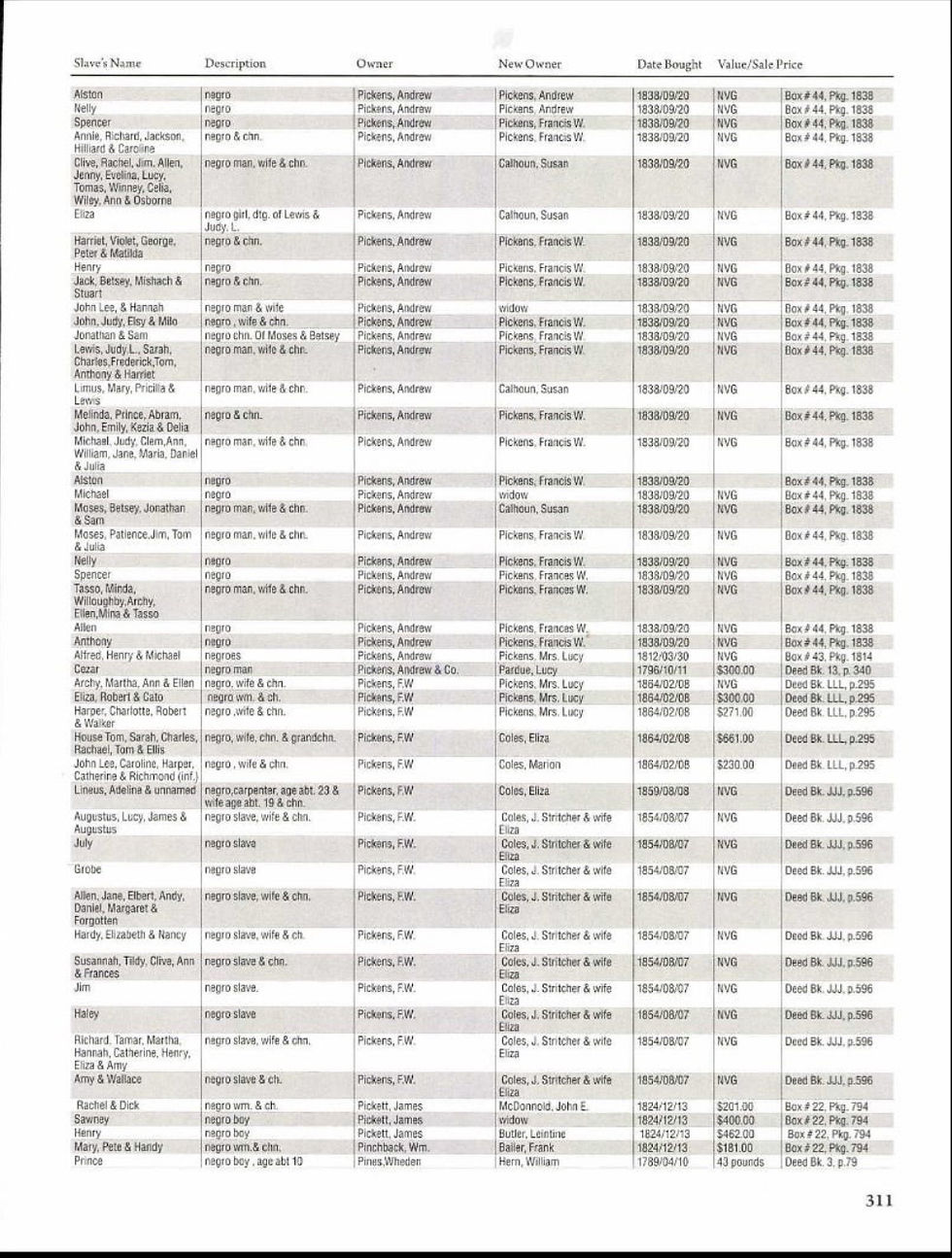
It's truly heartbreaking to witness my ancestors being dehumanized in these records, referred to as cattle rather than human beings. The unimaginable torture and abuse they endured is beyond comprehension. Yet, I am deeply inspired by their resilience and proud to be descended from such strong, remarkable individuals.
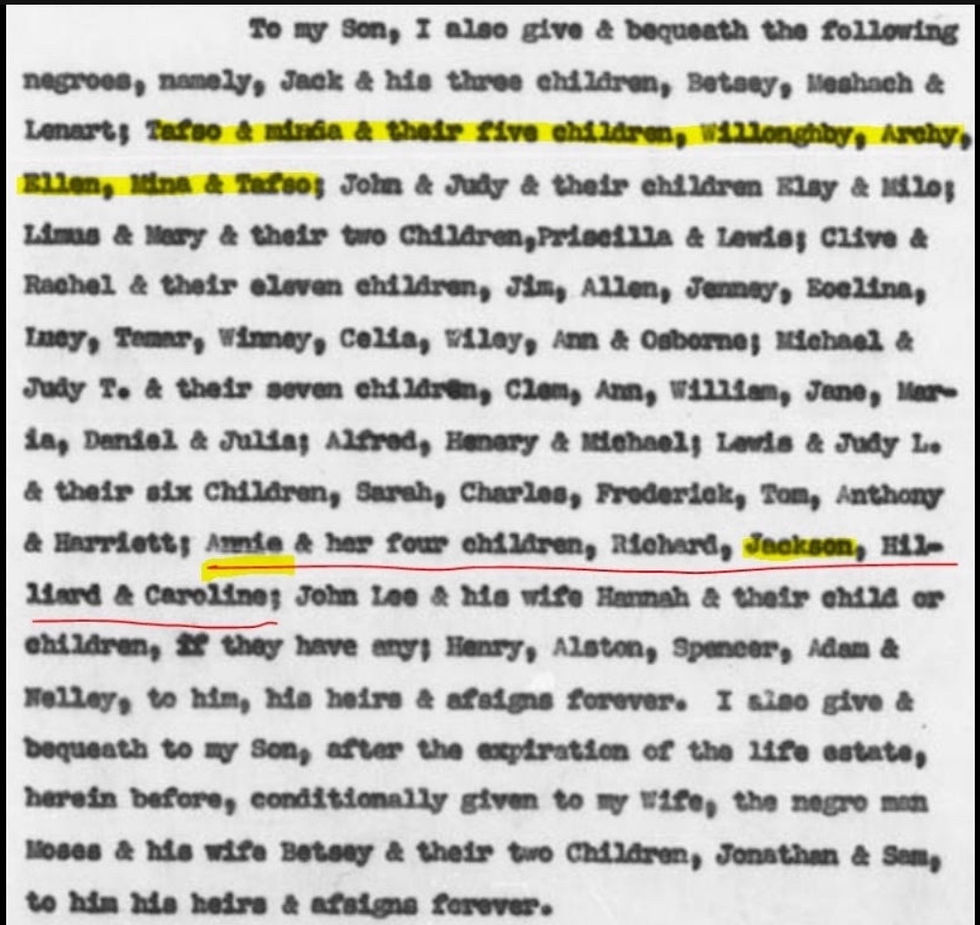
An excerpt of the will states, "To my son, I also give & bequeath the following negroes, Jack & his three children Betsey, Meshach, & Lenart; Tafso & Minda & their five children, Willonghby, Archy, Ellen, Mina & Tafso;"
In 1864, my ancestor Archie (son of Tasso and Minda), his wife, and his daughters Ann and Ellen (my 3rd great-grandmother) were given to Mrs. Lucy Pickens by the previous owner, Francis Pickens, due to his death. Lucy's maiden name is Holcombe, and she was the widow of Francis Pickens.


It's difficult to comprehend the cruelty with which human beings treated others, viewing my ancestors and many others as mere property rather than fellow living beings. My enslaved ancestors were denied autonomy and robbed of their freedom. I want to emphasize the profound privilege I feel to have access to these records, as many others in the diaspora do not have the same opportunity to trace their ancestors. Some records didn't even acknowledge our ancestors by name, reducing them to mere ages. It's disturbing and heart-wrenching to confront these records, yet I'm grateful to possess them so that future generations of my family can remember their roots and identity. This history should be taught openly in schools rather than hidden away. Some of my ancestors (including Archie Simpa), born into slavery, lived into the 1900s. This is recent history, not distant past, and the intergenerational trauma is still felt by descendants today.
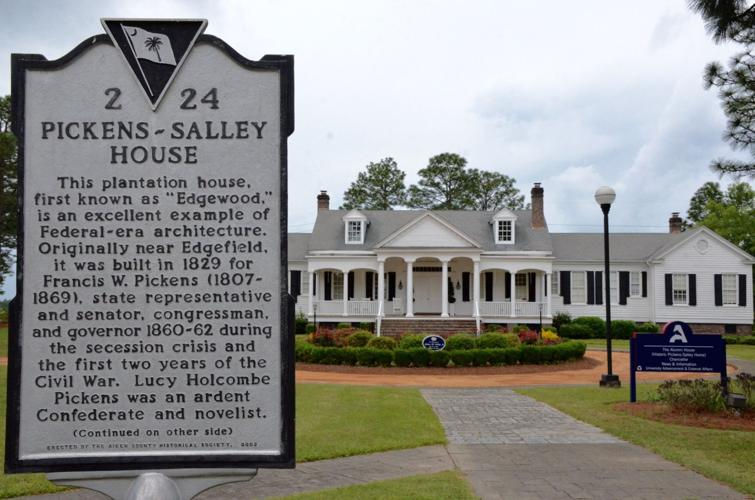
It's intriguing to note that Tasso Jr. (the son of Tasso and Minda), along with several of his children, relocated to Jefferson, Florida, as documented in the 1885 Florida State Census, the 1880 US Federal Census, and the 1870 US Federal Census.


Algie Simpo Sr. (the brother of Ann Simpo and Ellen Simpo, my 3rd great-grandmother) also moved to Florida and ended up dying in Duval, Florida, in the year 1934.

I believe this move was deliberate rather than coincidental. Jefferson, Florida, situated within the Chiaha chiefdom and Seminole territory, holds significance. The Seminoles historically intermarried with African individuals and engaged in conflicts and alliances, fostering Maroon communities. My ancestors lived during the time period of the Seminole Wars and likely were aware of these events. It's also plausible that they were motivated to relocate to Florida during the Reconstruction Era, drawn by the newly granted voting rights for African American men and the presence of a thriving African American community.
“In the early years of Reconstruction, Florida’s state and local governments were controlled by the Republicans, the same party that had acted in Congress to force the Confederate states to write new state constitutions acknowledging the end of slavery. Backed by African-Americans and supportive whites, the Republicans attempted to ensure political and social equality for freedmen.” - https://www.floridamemory.com/learn/classroom/learning-units/civil-rights/#Antebellum
DNA
The genetic makeup of the descendants of Tasso and Minda Simpa/Simpo confirms their ancestry from Africa. All documented descendants who have taken AncestryDNA tests share common ancestry from broad geographical regions such as Nigeria, Benin & Togo, Ghana, Congo, etc. Autosomal DNA tests alone cannot pinpoint specific ethnic tribes. Descendants usually show West/Central African, Malagasy, European, and sometimes Native American ethnicities on DNA tests.

Cultural Preservation
It's crucial to emphasize that certain elements of pride persist within the descendants of Tasso and Minda Simpa/Simpo. Some descendants possess artistic talents, reflecting the renowned West and Central African traditions of sculpture and artistic expression. Others have skills in braiding and maintain West African hairstyles, while some engage in aspects of Yoruba and Edo spirituality, among other African spiritualities. Certain descendants are actively learning various African ancestral languages, including Edo, Malagasy, or Yoruba. Additionally, many descendants have a deep appreciation for Nigerian and other African cuisines. Some descendants can prepare staple dishes like Egusi or Okra soup. Despite the painful legacy of having ancestors forcibly taken, some descendants aspire to visit present-day Nigeria along with other African countries to reconnect with long-lost relatives. Furthermore, descendants of Tasso and Minda are eligible for membership in the Sons & Daughters of the United States Middle Passage.
Photos
Please note that the family photos accessed publicly through AncestryDNA are based on what has been shared by descendants. The accuracy of these family connections and ties depends on the information provided by those who uploaded the photos.


The 1880 census shows Archie and his wife, Martha Simpo, are living in the same household as their daughter Ann Simpo and their grandchildren (the aforementioned Ellen and Mattie), along with Lou Cook. Lou Cook is my 2nd-great-grandfather (David Cook's) sister.
In closing, I express my gratitude to all the family genealogists and historians whose efforts have made this article possible. Without the dedication of volunteers and individuals delving into archives, I, as a descendant, would not have access to the knowledge and information about this lineage. I hope that this article aids others in tracing their African ancestors and instills a sense of pride in descendants regarding their heritage, despite the brutal truths of the trans-Atlantic and Indian Ocean slave trades.
Note: If you are a descendant of these lineages, have inquiries, possess new information for the article, or suspect a connection to these lines, please don’t hesitate to reach out via email at afroindigenousyesa@gmail.com.


Comments