Me:ku (Welcome)
to My Site!
The name of my website, Nosy Ambiroa, derives from the Malagàsy words “Nosy” meaning island and “Ambiroa” meaning soul. This name honors my ancestral connections to the islands of the Caribbean, coastal tribes in West, East & Central Africa, Madagascar, and Turtle Island, the Indigenous name for the Americas. The presence of water and the shoreline have long been sources of comfort and grounding in my life.


A picture of me wearing a Malagasy lambahoany.
Note: Although this website is a digital space, I still reside in Lenapehoking. Therefore, it is only right to pay respect to the Indigenous peoples of the land I am inhabiting.
Land Acknowledgment in Yesą:sahį:
Hena Amai bi:wa. Wāktāka Ramapough-Lenape, piláhuk. Yima ya-tī-pu-Yuke-wa nēi. Mima Lenape amą:i onąhé. Lenape Yesą nikas, “Amai nikas Lenapehoking Mįgikohane:la.” Mąkyądoste:kise Lenapehoking. Amą:i. bi:wa.
(This land acknowledgment was inspired by Corey Roberts’ land acknowledgment, see: Roberts, Corey. (2020). A Grammar Sketch of Tutelo-Saponi (Master’s thesis, University of Arizona, Tucson, USA).)
English translation:
Thank you, Mother Earth. Thank you to the Ramapough Lenape people. You have lived here. We are standing on Lenape Land. The Lenape people say the land says, “Lenapehoking is my name.” We love Lenapehoking. Thank you to the land/the land is good.
About Me
Introduction in Yesą:sahį:
Kihoe hu:kmekureme:čʰen! Mįyątipi:wa mįgikohane:la. Mima wahta:ka Yesą nikas Lukaîri, nikas Kauwets'a:ka nikas Powhatan. Mima ąyaa sapi, Yorùbá nikas Gàsy nikas Edo. Lenapehoking amą:i watíwa Amanishuck atʰí: mįgi:tǫwi Yesáh amá onąhé. Yesa:sahį nikas Malagasy nikas Kaliponam owakláka. Hena Amai Bi:wa. Ale:wa!
Introduction in Malagàsy:
Salama! Jala ty anara’ko Baka Lenapehoking raho telo amby roapolo tao raho. Tea’ko Mihina Sakafo. Misaotra.
Introduction in Kalipona:
Jala Mįyątipi:wa Simpa niri. 24 chiriko nào. Amanishuck-na nukuya. Lenapehoking narímetoyem.
Introduction in English (Explaining My Complex Family History and Intersectional Identity):
Greetings, my name is Jala (Jay-lah) Mįyątipi:wa Simpa. Mįyątipi:wa means “I am happy” in Yesà:sahį, and Simpa is my Indigenous African family surname inherited from my Makua 5th-great-grandparents, Tasso & Minda Simpo/Simpa. I am a Yėsą Indigenous woman of the Occaneechi Hayes and Freeman families from Brunswick, Lunenburg, and Mecklenburg counties in Virginia. My family’s roots span Akų:čuk within Amanishuck (North Carolina/Virginia Piedmont) and Corrowaugh within Tsenacommacah (Virginia Tidewater). My lineage includes both Free People of Color (FPOC) and enslaved ancestors.
Image Source: The Wilson Quarterly
My lineage includes Malagasy (Merina) roots, which include East African Bantu and Southeast Asian heritage, along with Mozambique’s Makua and other Southeastern Bantu peoples. West and Central African (Yorùbá, Igbo, Fulani, Mandinka, Ewe, Wolof, Fon, Bakongo, Bamiléké, and others); Eastern Woodlands (Occoneechee Yesą, Kauwests’aka King line Θkwarí•nę urʔcę́hseh clan, Powhatan, and others); Caribbean (Taíno/Lukku-Cairi); Southwestern/Southern Indígena; and Northern, Eastern, and Southern European roots stemming from enslavement, interracial unions, and Scots-Irish indentured servants in the colonies.
Migration & Diaspora
My heritage extends to the Caribbean (Yamayeka/Jamaica, Caya Hico/Turks & Caicos, Bermuda, Ichiroiganaim/Barbados, and Kairi/Trinidad and Tobago), Guadalajara, Jalisco, Mexico, and the US Southwest (New Mexico) via the Indian, Indian Ocean, and Atlantic slave trades, as well as forced migrations during the internal slave trade from Virginia, South Carolina, North Carolina, and Maryland to Georgia and Alabama. This includes more recent movement during the Great Migration from Southern states to Lenapehoking (New Jersey) and Ithaca, New York, during the early to mid-1900s. While many migrated, some branches of my family remained in their homelands, and since the 2000s, some descendants have moved back.
Image Source: Slave Voyages, "Overview of the slave trade out of Africa, 1500-1900."
Work & Purpose
Raised in Lenapehoking, I bring the perspective of a neurodivergent, disabled person to my work in decolonization, healing, and Afro-Indigeneity. With a Bachelor’s in Psychology and an MSW, I am devoted to preserving ancestral histories through storytelling and genealogy.
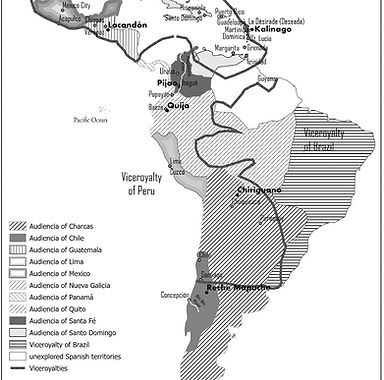
Image Source: Cambridge University Press, "Indigenous Groups in Spanish Americas Targeted for Crown-Sanctioned Slavery, 1547-1620."
The Indian Slave Trade, which spanned from 1492 to 1880, involved the forced enslavement of an estimated 2 to 5.5 million Indigenous peoples across Turtle Island (the Americas). Enslaved Native individuals were not only exploited throughout the continent but were also transported overseas to regions such as Spain and North Africa (Brown University, 2017).