
Malagasy Women Enslaved in the Deep South

Updated: Sep 6

While conducting my own genealogical research, I have come across a pattern. Multiple DNA matches (some of whom are directly descended from the same female ancestors) have Malagasy maternal haplogroups on 23andMe and FamilyTreeDNA. These ancestors weren't enslaved in Tidewater Virginia (which is more well-known among US Malagasy-descended people). On my dad's side, I do have Malagasy ancestors from Tidewater Virginia, which I have written about in previous genealogical articles.
DNA relatives on my mother's side descend from Malagasy women enslaved in Georgia and Alabama. My family has roots in both states, including Henry County, Alabama, and Stewart and Early counties, Georgia. Heavy endogamy on this side of the family causes me to descend from a Malagasy ancestor more than once, alongside having multiple Malagasy ancestors on both my paternal and maternal sides.
On my mother's side, we share Merina Malagasy, Mauritian, and South African DNA matches with relatives who descend from Malagasy people enslaved in Georgia and Alabama. The Mauritian and South African DNA matches descend from Malagasy people enslaved in Mauritius and South Africa.
Noticing this pattern has caused me to pose three questions (which will be explored further in this article):
1) How did these Malagasy women end up in Alabama and Georgia?
2) Were there any Malagasy cultural retention or oral histories that survived?
3) Were there small, distinct Malagasy-descended communities in Alabama and Georgia during slavery?
I have been able to partially answer certain questions by conducting further research, but I want to make it clear that I am still in the beginning phases of this work. My work is specifically in genealogical revitalization, documenting hidden histories of my ancestors alongside sharing these stories in the hope that others learn more about their lineage. I want to emphasize that I am not claiming that these Malagasy ancestors were of only Malagasy descent. These ancestors lived in the 1800's and 1900's. It is highly likely they also had West/Central African, European, and/or Native lineage as well. I will update this article with more information as we go.
The maternal haplogroups of DNA matches who descend from Malagasy women in Alabama and Georgia are:
M23 (found exclusively in Madagascar)
M32c/M32 (which occurs at a high frequency among my DNA matches)
E1a1a (which is included in the Malagasy people's genetic group on 23andMe posted below)
B4a1a1
B4a1a1a
Note: I am blurring out personal information to protect the privacy of people involved.


Genetic Groups/Communities Shared in Common with DNA Matches:


23andMe Ancestry TImelines and 23andMe & AncestryDNA Maps:

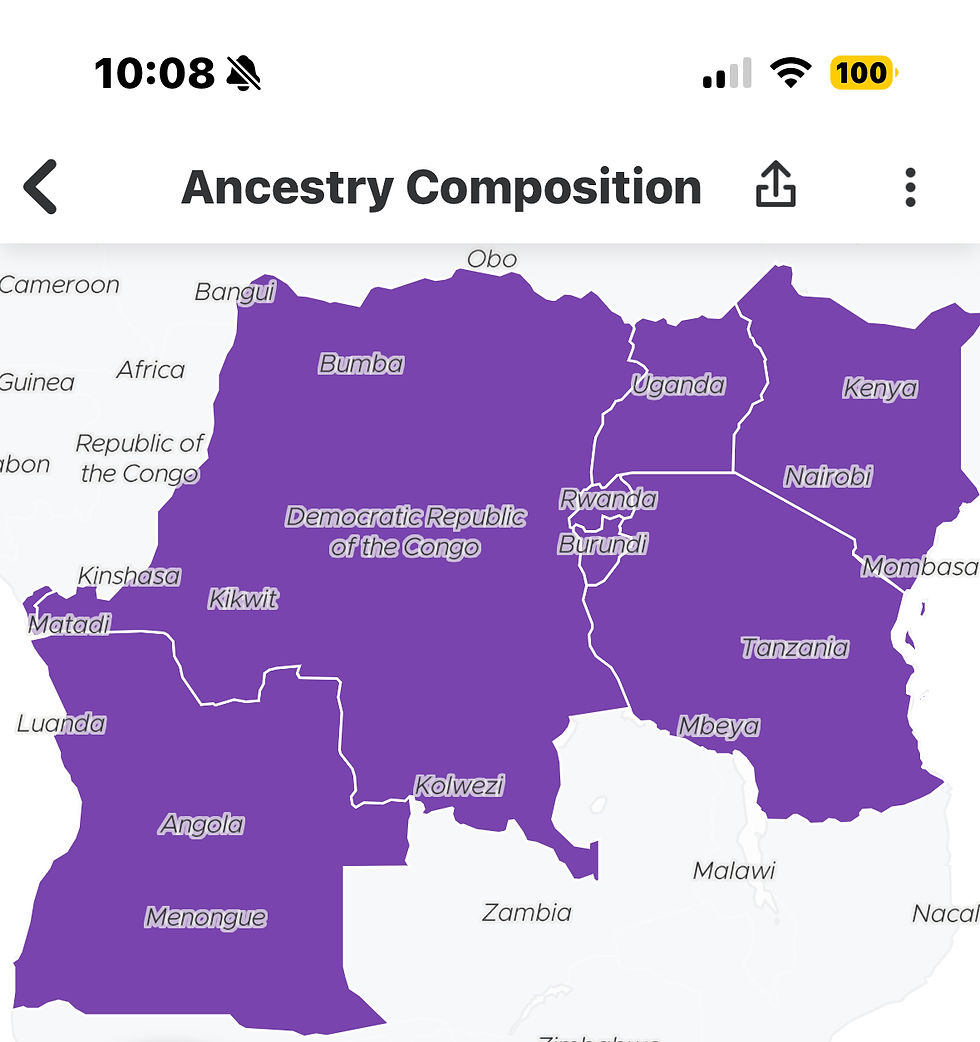


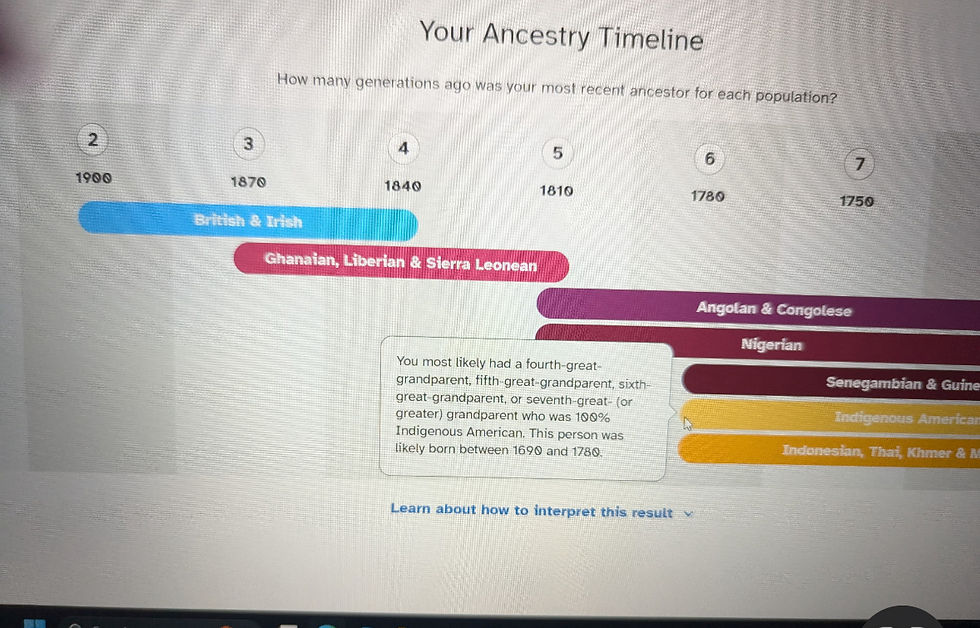
How did these Malagasy women end up in Alabama and Georgia?
According to family oral history, some of my ancestors in Georgia and Alabama were victims of the domestic slave trade. Originally born in Virginia, North Carolina, South Carolina, and Maryland, they were forced to walk on foot in slave coffles, with some even remembering the rivers they crossed. This oral history is corroborated by federal census records, death certificates, and genetic communities confirming birthplaces in those states.

Further research is needed to identify the specific enslavers and plantation locations. This could help determine any connections to Virginia families like the Ragsdales and Carters, who enslaved Malagasy people. Finding out if these plantations were near each other, and if specific enslavers in the aforementioned states were known for enslaving Malagasy people, could help determine whether Malagasy-descended communities existed. This can also assist in figuring out if any communal or familial cultural retention occurred.
There was also an illegal slave trade where Malagasy people during the 1800's were trafficked to the so-called Americas (aka Turtle Island).
In Dr. Wendy Wilson-Fall's book titled Memories of Madagascar and Slavery in the Black Atlantic on page 101, she states, "The illegal trade was complex and geographically diverse. To avoid British antislavery brigs and American customs officials who had not been corrupted by the brisk and voluminous winnings available, slavers bought transshipped slaves who had been brought across the Atlantic to the market of Cuba, Brazil, and Mexico and even made occasional daring trips back to the continent of Africa. Often, saltwater slaves were brought from the Caribbean and South America under the guise of being natives of the Americas. Others were contraband brought in clandestinely to the numerous river ports of Alabama, Georgia, and Florida."
I'm wondering what cultural impact these Malagasy people had on the already enslaved population in Alabama and Georgia. I also wonder if any ancestors who were originally enslaved in the Caribbean, including Jamaica, and then sent to Georgia and Alabama were of Malagasy descent. Jamaica and Barbados did get a pretty decent number of Malagasy who were enslaved on those islands. Dr. Wendy Wilson-Fall (2015) theorizes that after the ban on the Trans-Atlantic slave trade, Malagasy were brought into the US during the 19th century through southern routes (such as South Carolina and Georgia), which would explain numerous amounts of families having oral history of an ancestor being born in Madagascar.


Were there any Malagasy cultural retention or oral histories that survived?
In Dr. Wendy Wilson-Fall's book titled Memories of Madagascar and Slavery in the Black Atlantic, she mentions a domestic slave trade where thousands of enslaved people were sold to cotton plantations in Kentucky, Alabama, Tennessee, Mississippi, and even New Orleans.
In Alabama, Dr. Wendy Wilson-Fall mentions descendants of Cochina Eley from Talladega County, Alabama, who was enslaved on the Stockdale Plantation. According to oral history from descendants, Cochina was born in Madagascar. In my own personal research, I have come across southern families from South Carolina, Virginia, Alabama, and Georgia having oral history of an ancestor from Madagascar.
Enslaved African people on the South Carolina and Georgia coasts were responsible for cultivating Asian rice, widely known as Carolina Gold rice.
"Did you know that pirate John Thurber has been considered as the person who introduced rice to America? He brought the first shipment of rice to America on his return voyage from Madagascar. In 1685, John Thurber’s ship was damaged in a storm and blown off course. He stopped in Charleston, South Carolina for repairs where he met doctor and explorer Henry Woodward. In exchange for Woodward’s hospitality and assistance, Thurber gave him a bag of seed rice from Madagascar. Woodward then planted the rice and found out how well it flourished in the marshy Carolina soil."- History of Rice in South Carolina| Carolina Snaps by David Dinkins, South Carolina ETV
We can thank Malagasy, West and Central African ancestors for cultivating Carolina Gold Rice which is still grown and eaten today. There needs to be more information collected from descendants (especially from older generations) of enslaved Malagasy in these areas to see if any spiritual beliefs, culinary dishes, familial traditions, or even linguistic expressions that are distinctly Malagasy have been passed down. There are definitely West & Central African, European, and, in some cases, Native cultural influences that have been preserved in my family.
Were there small, distinct Malagasy-descended communities in Alabama and Georgia during slavery?
In order to answer this question, I will need to collect more data.
Research Interest:
Surnames: Trawick/Traywick, Brackin/Brackins, Hollis, Kirkland, Bryant/Bryan, Humbler, Jones, Tolbert/Talbot, Hutchins/Hutchison/Hutcheson
Locations: Alabama (more specifically, Henry County, Houston County, Dale County, Coffee County, Geneva County, Covington County, Crenshaw County, Pike County, Butler County, and Barbour County). Georgia (more specifically, Early County, Stewart County, Randolph County, Terrell County, Clay County, Calhoun County, and Baldwin County). My point of focus will be lower Alabama, specifically the southeastern counties, and Early County, Georgia, with a concentration in Blakely.
Please email me at afroindigenousyesa@gmail.com if you have:
Ancestors from the listed states, counties, or surnames, with suspected Malagasy lineage from those lines.
A Malagasy maternal haplogroup (such as M23, M32c/M32, E1a1a, B4a1a1, B4a1a1a) or a paternal haplogroup (such as O1a-M119 and O2a-M95).
Family oral history of ancestors born in Madagascar or having Malagasy ancestry who were enslaved in either Georgia or Alabama.
Southeast Asian and Southeast African ethnicities on DNA tests.
Genealogical records proving Malagasy lineage, such as:
Census records in Alabama or Georgia documenting an ancestor's or parent's birthplace as Madagascar.
Records showing an ancestor with a Malagasy name.
Wills, deeds, or estate records showing the family who enslaved your ancestor(s) owned Malagasy people.
Family documents or court records of an ancestor identifying as Malagasy.
Feel free to send family photos, DNA test results, haplogroups, discuss family oral history, and show any documentation you believe proves a Malagasy ancestral connection. I believe our ancestors' stories deserve to be told. Identifying long-lost relatives and tribal/ethnic origins of enslaved ancestors is a priority to me.
By listening to oral histories, I can identify patterns and map the specific geographic locations in Alabama and Georgia where Malagasy ancestors lived. This helps determine whether Malagasy communities existed in the area and whether cultural retention was maintained. Even if we do not share a Malagasy ancestor, we can still identify which specific enslaver families enslaved Malagasy people and map their plantations.
The long-term goal is to:
Create an ancestry project on GEDmatch and/or FamilyTreeDNA for descendants.
Hold gatherings to revitalize our ancestral language and culture.
Reconnect with relatives still living in Madagascar.
Create a digital archive preserving our history.
It is a myth that we do not know who we are or that we are a people without roots. Our ancestors refuse to be erased and forgotten. Àṣẹ!
Works Cited
Artushfoto. A Photo of a Sakalava Malagasy Woman in Antsiranana, Diego Suarez Bay, Madagascar. 29 Oct. 2016. Dreamstime, www.dreamstime.com/artushfoto_info. Image ID 84571989.
"A Slave-Coffle Passing the Capitol." A Popular History of the United States, Scribner, Armstrong, and Company, 1876–1881. Library of Congress, http://hdl.loc.gov/loc.pnp/cph.3a06246
Dinkins, David. "History of Rice in South Carolina." Carolina Snaps, South Carolina ETV, www.scetv.org.
Wilson-Fall, Wendy. Memories of Madagascar and Slavery in the Black Atlantic. Ohio University Press, 2015.


Comments